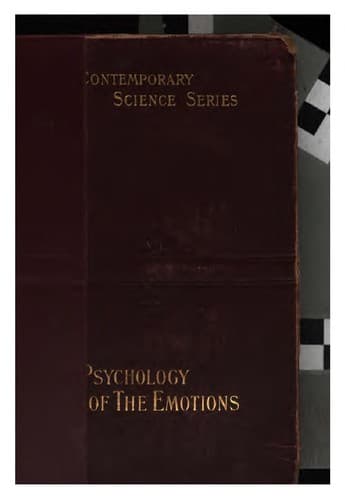
The Psychology of the EmotionsRibot, Th. (Théodule)
Science
The Psychology of the Emotions
Ribot, Th. (Théodule)
Emotions
The notion of the cosmic order led to that of a moral order; the
gods have first the physical government, in a later age the ethical
government of the universe. The conception of higher powers,
invested with moral attributes, has been, as we shall afterwards
see, an important stage in the evolution of the religious sentiment.
The very ancient opinion, still prevalent among many believers, that
the crimes of men occasion epidemics, unchain the elements, cause
floods and earthquakes, shows that the human mind, rightly or
wrongly, has supposed an analogy between all the forms of order in
the universe. Hence also the change of the physical dualism above
mentioned into a moral dualism; the genii of light and darkness
become respectively moral or immoral gods, good or bad counsellors,
saviours or tempters; and in this period a faith in the superiority
and definitive triumph of the good is firmly established. In short,
the gods have as attributes first power, then intelligence, and
lastly morality.
(2) Let us now see the part played by increasing generalisation in
the constitution of religious ideas.
When we wish to study the ascending degrees of generalisation, not
_in abstracto_, but according to facts and documents, we may take as
our guide the evolution of languages, or, better still, the progress
of the scientific spirit (as, for instance, by following the methods
of classification used in zoology, from antiquity up to the present
day); we might also have recourse to the development of religion,
for this is the same mental process applied to a different matter.
It is sufficient to indicate the various steps in a very cursory
manner.
It is a well known fact that the various races of mankind differ
greatly in their powers of abstraction and generalisation; some can
scarcely get beyond the concrete, while others disport themselves,
easily and swiftly, in the region of the abstract. This difference
of aptitude is expressed in their religions. Many peoples have never
passed beyond polydemonism—_i.e._, the cult of individual genii; in
other words, the realm of the concrete. Not to speak of savages,
such was the religion of the ancient Chinese empire (Tiele); such
the innumerable genii in the primitive religion of the Romans—a
people not greatly inclined to abstractions.
Certain tribes have, even at the present day, words to designate
every water-course in their country, but no general term for a
river. To have found such a one is a step in progress. It is the
same in the region of religious thought: by an analogous progress
the spirit of each tree is subordinated to the deity of the forest,
the various river-spirits to a river-god, etc. For a number of
particular divinities is substituted one specific and pre-eminent
divinity.
Public-domain text, read in full here on John Shaqi.
Reviews
Reviews
No reviews yet
Be the first to share your thoughts on this work.
Elsewhere in the archive
Join the Discussion
Join the discussion
Sign in to leave a comment or review.
Sign InorCreate an account