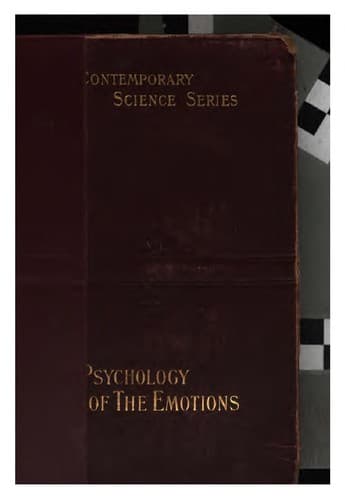
The Psychology of the EmotionsRibot, Th. (Théodule)
Science
The Psychology of the Emotions
Ribot, Th. (Théodule)
Emotions
At a higher stage the mind seizes more remote resemblances and
constitutes one god for water, one for fire, one for the earth, so
that the spirits of the waters, the sky, and the earth are severally
grouped under the dominion of one power, known in Greece as Zeus,
Poseidon, or Hestia.
This generalising process which has taken place with regard to
natural phenomena also goes on in the social order. There have been,
successively, gods of clans, tribes, nations. We know how long
religions—even complex and highly organised ones—have remained
merely national: the god of a nation is its protector and
guardian—watches over it and over nothing else; but his existence
does not exclude that of other gods who are lords of other nations.
The transition to the universal, extra-national religions was
brought about by means of conquest and annexation, but also, and
more particularly, by philosophical speculation.
At the point we have reached there are divine hierarchies,
analogous, on one hand, to the ideal hierarchy of individuals,
species, genera, on the other to the hierarchies of human society:
they are conceived and constituted according to the human type. The
anarchy of Vedic India is reflected in the mythology of the Vedas,
the feudality of Egypt in its religion, Zeus resembles Agamemnon,
the Peruvian Inca is descended from the sun, and applies to his
empire the government of the solar deity; and “by an optical
illusion, human society seems to be a copy of the Divine
State.”[195]
Footnote 195:
For details, consult Tiele, _Manuel de l’histoire des Religions_,
Goblet d’Alviella, pp. 153-163. “The divine feudality is the
primordial fact in Egyptian religion, as political feudality is
the primordial fact of Egyptian history” (Maspero, _Histoire
Ancienne_).
In its movement towards absolute unity, the human mind has still
some stages to pass through before reaching the term. It conceives
of a divinity far superior to the rest, who, however, act under him
(Jupiter optimus maximus), and whom he does not suppress. This is
“monolatry” but not monotheism. We still find accommodations and
compromises in the conceptions of triads (trinities) and dyads
(associations of masculine and feminine divinities). In fact, pure
monotheism is a conquest of the metaphysical spirit, which traces
back the series of secondary causes to discover the first cause,
rather than an intuition of popular consciousness.
This survey of ascending generalisation is somewhat schematic, and
has been presented as an ideal restoration, though all its elements
have been taken from reality. Some nations have attained the first
stages only; others have, with much difficulty, passed beyond them;
others have passed through several at a bound. Perhaps the evolution
of religious ideas has not been in any two cases identical.
Public-domain text, read in full here on John Shaqi.
Reviews
Reviews
No reviews yet
Be the first to share your thoughts on this work.
Elsewhere in the archive
Join the Discussion
Join the discussion
Sign in to leave a comment or review.
Sign InorCreate an account