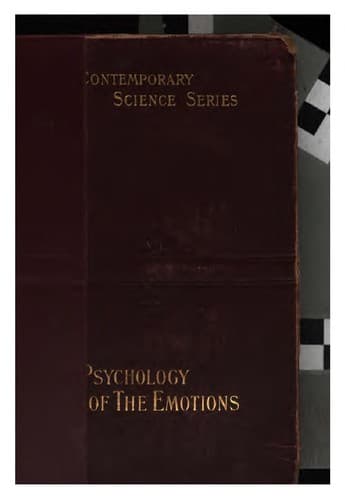
The Psychology of the EmotionsRibot, Th. (Théodule)
Science
The Psychology of the Emotions
Ribot, Th. (Théodule)
Emotions
The theory of _do ut des_ is expressed with naïve completeness in
a Brahmanic hymn. “Well filled, O spoon [of the sacrifice], fly
down; well filled, return. As having agreed on a price, let us
make exchanges of strength and vigour. Give me, I give to thee;
bring to me, I bring to thee.” Better still: "If thou wilt injure
any one, say to Surya: ‘Strike such an one, and I will make thee
an offering,’ and Surya, to obtain the offering, will strike him."
(Barth, _Les Religions de l’Inde_, pp. 25, 26.)
-----
For most religions, the supreme question is that of human destiny.
Its history, having traversed two periods, the one naturalistic, the
other moral, shows once more that the religious and the moral
sentiment are, in their origin, two totally distinct feelings.
During the first period, we find no idea of retribution according to
men’s works. The life after death is a continuation or copy of the
earthly life, sometimes resembling it exactly, sometimes
better,—most often worse. We know the complaint of Achilles, in the
_Odyssey_ (xi), where Homer has left us a vivid picture of this
primitive belief; men remain slaves, masters, chiefs, or kings, as
they were during life. Nay, certain tribes, projecting their
aristocratic prejudices into the other world, believed that the
souls of chiefs alone were immortal.
During the second period there arises a belief in a preliminary
judgment on men’s actions, decisive of their future destiny. The
conceptions of this future life are various: temporary or eternal
penalties and rewards, transmigration upwards or downwards, total
liberation (_Nirvana_), etc., but all resting on a moral idea. This
notion appears at an early age among the Egyptians, in the judgment
of Osiris and the weighing of the souls. In the “Book of the Dead,”
of which a copy was placed in the tomb with every mummy, the defunct
addresses to the god a long enumeration of the good deeds he has
done and the faults he has not committed; it is remarkable that he
speaks, not of his oblations, but of his virtues.[197]
-----
Footnote 197:
This prayer will be found in full in Maspero, _op. cit._ (4th
ed.), p. 38.
-----
III.
At the point we have reached, the religious feeling has attained the
height of its development, and can henceforth only decline, so that
the third period need not detain us long. It may be summed up in the
following formula: an ever-growing predominance of the intellectual
(rational) element, a gradual effacement of the emotional element as
it tends to approximate to the intellectual feelings and to come
under that category.
Public-domain text, read in full here on John Shaqi.
Reviews
Reviews
No reviews yet
Be the first to share your thoughts on this work.
Elsewhere in the archive
Join the Discussion
Join the discussion
Sign in to leave a comment or review.
Sign InorCreate an account