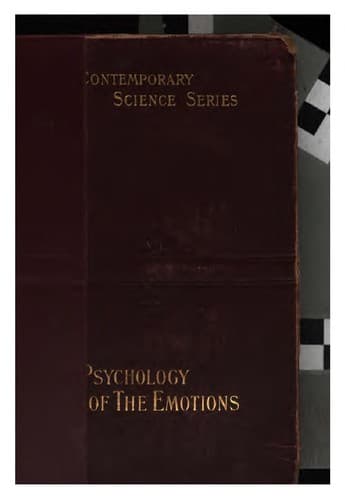
The Psychology of the EmotionsRibot, Th. (Théodule)
Science
The Psychology of the Emotions
Ribot, Th. (Théodule)
Emotions
When the march of thought towards unity has reached its limit in
pure monotheism, the work of theologians and especially of
metaphysicians tends to refine the conception of divinity, assumed
as First Cause, or moral ideal, or both at once, but always as an
inaccessible ideal, visible only in occasional glimpses. The
logical, necessary, inevitable consequence is the weakening of the
emotional state. In fact, we may lay down the following principle:—
From the perception to the image, and from the image to the concept,
the concomitant emotional element keeps on diminishing, other things
being equal; for we must take into account differences of
temperament and individual variations. This is only a summary way of
stating what I have so often said in Part I.: emotional states,
beyond all others, depend on physiological (visceral, motor, and
vaso-motor) conditions. Now it is clear that perception is the
operation which most rigorously demands complex organic conditions.
Among images or representations there are two categories: the vivid
and intense imagination approximates, by its hallucinatory tendency,
to the percept; while the cold and dull imagination, which is a bare
outline of things, approaches the nature of a concept. Finally, the
pure concept, reduced almost entirely to a sign, a substitute for
reality, is as much detached from organic conditions as it is
possible for a psychic state to be; it requires a _minimum_ of
physiology. In consequence, emotion, attacked at its source, flows
very scantily; and of the religious feeling properly so called there
remains only a vague respect for the unknowable—for the x—the last
survival of fear and a certain attraction towards the ideal which is
the last remnant of the love dominant during the second period.
We might say in clearer and simpler terms that religion tends to
become a _religious philosophy_, which is an entirely different
thing, for each corresponds to a distinct psychological condition,
one being a theoretic construction of argumentative reason, the
other the living work of a group of persons or an inspired great
man, involving the whole man, his thoughts and feelings. This
distinction is extremely important and throws light on our subject.
Public-domain text, read in full here on John Shaqi.
Reviews
Reviews
No reviews yet
Be the first to share your thoughts on this work.
Elsewhere in the archive
Join the Discussion
Join the discussion
Sign in to leave a comment or review.
Sign InorCreate an account