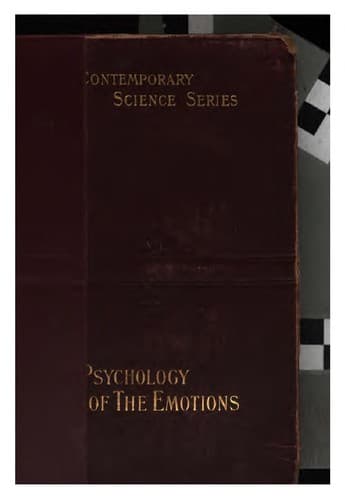
The Psychology of the EmotionsRibot, Th. (Théodule)
Science
The Psychology of the Emotions
Ribot, Th. (Théodule)
Emotions
During the primitive period, ritual is the _immediate and direct_
expression of the religious sentiment, and bears the stamp of the
national character. Among the Greeks, it was graceful and joyous, as
is fitting for divinities who are merely superior and happy human
beings. Among the early Romans it has an agricultural and family
character, is formalist and methodical; the omission of the minutest
detail invalidates the sacrifice. The Mexicans immolated human
hecatombs to divinities who were intoxicated with blood. Rationalist
religions, being half philosophical, have little ritual and a dry
liturgy; they resemble persons of phlegmatic temperament, whose
gestures are rare and restrained. The religions of the imagination
and the heart, on the other hand, manifest themselves by the
splendour and exuberance of their ceremonies.
In the second period, we have the passage from the literal to the
figurative; ritual becomes _symbolism_. Since it is a means of
expression, a language, it is quite natural that this should be so,
and this phase corresponds to that of metaphor in spoken language.
Thus the offering of a lock of hair, or a figure made of dough,
becomes a substitute for human sacrifice. Having reached this point,
ritual can no longer be understood except through its history; but
worshippers still use it, without fully knowing its meaning, just as
they use metaphors without knowing their derivation, or being able
to trace them back to their primary sense. Lastly, there are some
rites which are simply survivals, analogous to a frown when we are
perplexed, vestiges of certain ways of feeling and acting which have
been, but have long ago disappeared.
The religious feeling is therefore a complete emotion, with its
train of physiological manifestations, and those writers who have
classed it among the intellectual feelings have only considered it
under its higher forms, and when it is on the point of extinction.
At the period of its fullest development, but rarely under either
its primitive or its intellectualised form, the religious feeling
may become a passion, yielding to no other in tenacity and violence,
which has its own special name: religious fanaticism. It borders on
madness without quite crossing the line. This passion would require
a psychological monograph to itself; and there is no lack of
documents whence to compose one. We may gather from these facts:
Public-domain text, read in full here on John Shaqi.
Reviews
Reviews
No reviews yet
Be the first to share your thoughts on this work.
Elsewhere in the archive
Join the Discussion
Join the discussion
Sign in to leave a comment or review.
Sign InorCreate an account