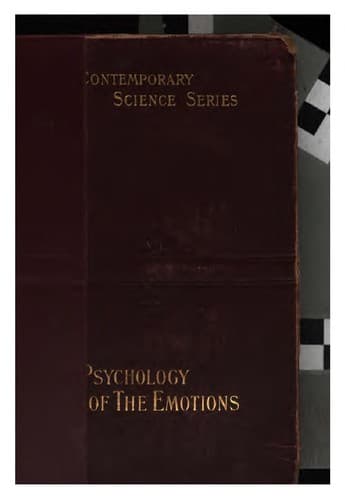
The Psychology of the EmotionsRibot, Th. (Théodule)
Science
The Psychology of the Emotions
Ribot, Th. (Théodule)
Emotions
1. New proofs of the fundamental independence of the religious and
of the moral sentiments. In religious wars, persecution, the
torture inflicted on heretics, the murder of the chiefs of the
opposite party, are held to be meritorious acts; all which seems
inexplicable to persons of calm and deliberate sense. They would
be less astonished if they would consider that religious emotion,
when it reaches the point of a paroxysm of passion, becomes as
uncontrollable as violent love, and, like it, must have
satisfaction; that there is the firm belief in a right, superior
to human obligations, because of higher origin (a belief attaining
its highest degree in theomania, of which we shall speak
presently); and that the religious sentiment and the moral
sentiment, though having numerous points of contact and moments of
fusion, are yet, in their nature, essentially distinct, because
answering to two totally distinct tendencies of human nature.
2. We find a proof of the tendency of the religious feeling to
unite, group, _socialise_. Unity of belief creates the religious
community, as community of external and internal interests creates
the civil community. Both tend to expel dissidents (internal
enemies), and to conquer external enemies—in this case, the heathen.
The distinct or vague consciousness of the conditions of a society’s
existence, _i.e._, its instinct of conservation, determines its
morality and its way of acting. National religions, therefore, which
are the same thing as civil society, proselytise only slightly, or
not at all: the Greeks never tried to convert the Persians, neither
did the Romans the Gauls. The universal religions (Christianity,
Islam, Buddhism) forming societies other than, and outside
nationality, and transcending it, have aimed at spiritual conquest,
_i.e._, at their social extension.
IV.
Public-domain text, read in full here on John Shaqi.
Reviews
Reviews
No reviews yet
Be the first to share your thoughts on this work.
Elsewhere in the archive
Join the Discussion
Join the discussion
Sign in to leave a comment or review.
Sign InorCreate an account