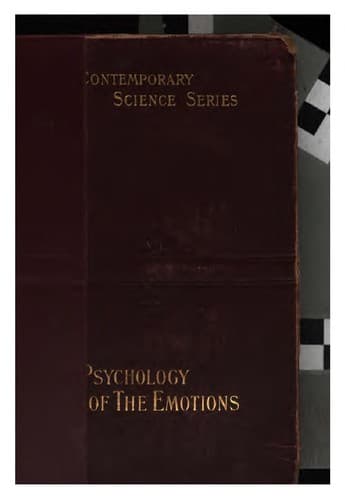
The Psychology of the EmotionsRibot, Th. (Théodule)
Science
The Psychology of the Emotions
Ribot, Th. (Théodule)
Emotions
The question whether there exist any tribes completely devoid of all
religious belief has been extensively discussed. That there are any
such seems doubtful, when we take into account, on the one hand, the
reticence of the savage towards strangers with regard to his own
feelings and beliefs; and on the other, the scanty psychological
equipment of travellers, who frequently understand by religion only
a developed and organised cult. The fact, even were it proved, would
be but of slight value, since it could only be the case among the
very lowest specimens of humanity.[199] A question scarcely ever
asked is this: Are there _individuals_ (not social groups) utterly
without religious feeling? We must eliminate idiots, imbeciles, and
the uneducated deaf and dumb; we are speaking of normal men living
in some society or other, all of which have a religion. I am
distinctly inclined to answer in the affirmative, though I find no
decisive observation on this point. The case would be analogous to
those of moral blindness already studied, to the absence, if it
exists, of all æsthetic feeling; it would denote a lacuna in the
emotional life. It should be noted that it is only in this
department that such a lacuna can occur. No normal man, living in a
society, can have his mind closed to religious _ideas_, can ignore
their existence, their object, their significance; but they may have
no hold on him, may remain within his consciousness as a foreign
substance, originating no tendency and exciting no emotion; they may
be conceived without being felt.
-----
Footnote 199:
For this discussion, Tylor, _Primitive Culture_, I. xi., and
Réville, _Religions des Peuples non Civilisés_, i., pp. 10 _et
seq._, may be consulted.
-----
I have already reminded the reader that the religious feeling may
become a violent passion; it may even pass this limit, take a
chronic form, and enter the region of pathology. For the alienist,
religious madness is not a morbid entity, but a symptom; it
sometimes exists by itself, but is more often associated with
epilepsy, hysteria, and the forms of melancholia. From a
psychological point of view, it has to be studied by itself, as a
complement to the normal state. Considered thus, from the purely
psychological standpoint, its manifestations, though very diverse,
may be reduced to a simple classification: the depressive, or
asthenic; and the exalted, or sthenic forms.
Public-domain text, read in full here on John Shaqi.
Reviews
Reviews
No reviews yet
Be the first to share your thoughts on this work.
Elsewhere in the archive
Join the Discussion
Join the discussion
Sign in to leave a comment or review.
Sign InorCreate an account