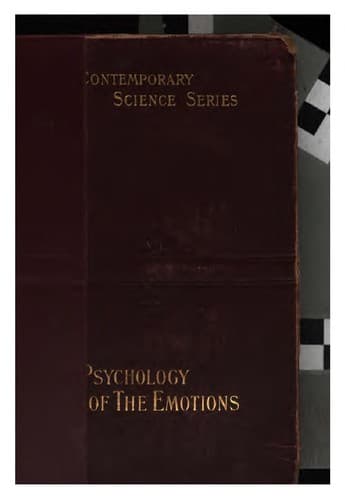
The Psychology of the EmotionsRibot, Th. (Théodule)
Science
The Psychology of the Emotions
Ribot, Th. (Théodule)
Emotions
The doctrine which I have called physiological (Bain, Spencer, Maudsley,
James, Lange[1]) connects all states of feeling with biological
conditions, and considers them as the direct and immediate expression of
the vegetative life. It is the thesis which has been adopted, without
any restriction, in this work. From this standpoint feelings and
emotions are no longer a superficial manifestation, a simple
efflorescence; they plunge into the individual’s depths; they have their
roots in the needs and instincts, that is to say, in movements.
Consciousness only delivers up a part of their secrets; it can never
reveal them completely; we must descend beneath it. No doubt it is
awkward to have to invoke an unconscious activity, to call in the
intervention of an obscure and ill-determined factor; but to wish to
reduce emotional states to clear and definite ideas, or to imagine that
by this process we can fix them, is to misunderstand them completely and
to condemn ourselves beforehand to failure.
-----
Footnote 1:
It may be doubted whether all the English writers here mentioned can
be strictly classed with the physiological school as understood by M.
Ribot. With regard to Mr. Spencer, for instance, this is indicated by
a brief summary of his own position in a private letter to the Rev.
Angus Mackay, who had presented a statement of the “confused
intelligence” theory, “which I conceive to be a part of the truth,”
wrote Mr. Spencer, adding that “joined with the dimly aroused
association of ideas derived from the experiences of the individual, I
hold that the body of the emotion consists more largely of the
inherited associations of experiences and still more vague states of
consciousness which result from excitement of them.” It is clear that
the evolutionary view does not necessarily fall wholly into the
“physiological” group.—ED.
-----
For the rest, this is neither the place to criticise the intellectualist
thesis, nor to justify the other in passing; the whole work is devoted
to this task.
The book consists of two parts. The first studies the more general
manifestations of feeling: pleasure and pain, the characteristic signs
of this form of psychic life, everywhere diffused under manifold
aspects; then the nature of emotion, a complex state which in the order
of feelings corresponds to perception in the order of knowledge.
Public-domain text, read in full here on John Shaqi.
Reviews
Reviews
No reviews yet
Be the first to share your thoughts on this work.
Join the Discussion
Join the discussion
Sign in to leave a comment or review.
Sign InorCreate an account