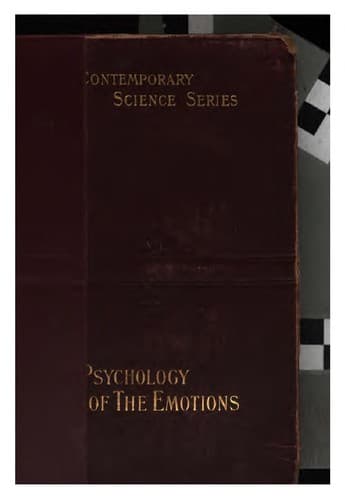
The Psychology of the EmotionsRibot, Th. (Théodule)
Science
The Psychology of the Emotions
Ribot, Th. (Théodule)
Emotions
Concerning the origin of passion, moralists and novelists have
remarked that it comes into being in two different ways—by a
thunderbolt or by “crystallisation,” by sudden action or by slow
actions. This double origin denotes predominance either of the
affective life or of the intellectual life. When passion is born
suddenly it issues directly from emotion itself and retains a
certain violence of nature, so much at least as its metamorphosis
into a permanent disposition admits. In the other case the
initiative is taken by the intellectual states (images, ideas), and
the passion is slowly constituted as the result of association which
itself is only an _effect_, for it obeys a latent influence, a
hidden factor, an unconscious activity only revealed by its work.
Representations only attract each other and associate by reason of
their affective similitude, of the emotional tone which is common to
them, and by successive additions these little streams form a river.
This form of passion, on account of its origin, has less ardour and
more tenacity.
After distinguishing passion from emotion, it is still necessary to
separate it from insanity, its other neighbour. Certain authors have
at once classed all passions with insanity; I cannot accept this
proposition. It may suit the moralist, by no means the psychologist.
But the task of separation is very delicate, and cannot be attempted
in this Introduction. The distinction between the normal and the
morbid, always difficult, is especially so in the case of the
psychology of the feelings. I shall endeavour elsewhere (Part I.,
Chap. iv.) to find the indications which enable us to establish this
separation legitimately, and the task which we now put aside in its
general form will come before us later on in the case of each
particular emotion.
PART I.
GENERAL PSYCHOLOGY.
CHAPTER I.
PHYSICAL PAIN.
_Its anatomical and physiological conditions; pain nerves,
transmission to the centres—Modifications of the organism
accompanying physical pain: circulation, respiration,
nutrition, movements—Are they the effects of paint?—Pain
is only a sign—The analgesias: unconsciousness of pain and
intellectual consciousness—Retardation of pain after
sensation—Hyperalgesia—Nature of pain: theory that it is a
sensation; theory that it is a quality of sensation—Pain
may result from the quality or the intensity of the
stimulus—Hypotheses regarding its ultimate cause: it
depends on a form of movement, a chemical modification._
Public-domain text, read in full here on John Shaqi.
Reviews
Reviews
No reviews yet
Be the first to share your thoughts on this work.
Join the Discussion
Join the discussion
Sign in to leave a comment or review.
Sign InorCreate an account