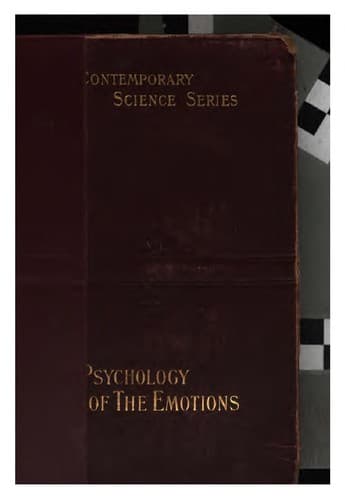
The Psychology of the EmotionsRibot, Th. (Théodule)
Science
The Psychology of the Emotions
Ribot, Th. (Théodule)
Emotions
However disposed we may be to restrict the part played by the
brain—that is to say the cortical layer—it remains a predominant
factor and the final terminus in the process of transmission. Here
we plunge into darkness. Researches into cerebral localisation teach
us on this subject nothing which is generally admitted. During the
first period of such studies, which may be called that of
circumscribed localisation _à outrance_, Ferrier placed the seat of
the emotions in the occipital lobes, because, in his opinion, that
region of the cortex receives the visceral sensations, because the
sexual instinct is dependent upon them, and finally, because these
lobes are more developed in women than in men. It is needless to
bring forward the numerous criticisms of this thesis. During the
second and present period of localisation, which may be called that
of disseminated localisation, functional rather than anatomical,
authors are little inclined to admit a particular centre for the
affective life in general, and still less for pain. All the sensory
centres, and even all the motor centres (perhaps there are
fundamentally only sensori-motor centres with preponderance of one
or the other element), may under certain conditions of activity
produce in consciousness a feeling of pleasure or pain.
The hypothesis of a cortical centre is not, therefore, probable; I
shall return to this point in discussing the emotions.
II.
The modifications of the organism which accompany physical pain have
been so often described that it is enough to trace a slight outline
of them. They may be reduced to a single formula: pain is associated
with diminution and disorganisation of the vital functions.
1. It acts on the movements of the heart, generally decreasing its
frequency; in extreme cases the slackening may go so far as to
produce syncope. In animals submitted for experiment in the
laboratory, even after removal of the encephalon, painful
impressions diminish the cardiac contractions. In man, though the
frequency of the pulse is sometimes increased in one form or
another, there is always a modification of the rhythm appreciable by
the sphygmograph. Bichat was right when he said: “If you wish to
know whether pain is real, examine the pulse.”
Public-domain text, read in full here on John Shaqi.
Reviews
Reviews
No reviews yet
Be the first to share your thoughts on this work.
Join the Discussion
Join the discussion
Sign in to leave a comment or review.
Sign InorCreate an account