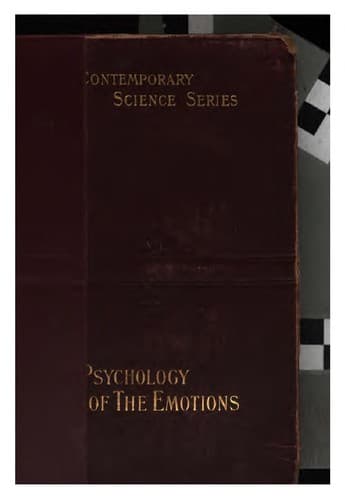
The Psychology of the EmotionsRibot, Th. (Théodule)
Science
The Psychology of the Emotions
Ribot, Th. (Théodule)
Emotions
These facts—and we shall find analogous ones in other chapters,
under other headings—show that, as we have seen in the case of pain,
pleasure does not depend simply on the _quantity_ of excitement. To
attribute all pleasures to excitements of medium energy is
equivalent to the formula: “Pain is due to an intense and prolonged
excitement.” In both cases intensity alone is emphasised; but there
are pleasures irreducible to medium energy and depending on the
_quality_ of the excitement and the nature of the sentient subject.
Will it be said that sexual pleasures are the concomitants of a
medium activity? The pleasure produced by harmonious chords is, for
a musical ear, a matter of quality, not of intensity. We find it
impossible, therefore, to reduce the objective conditions of
pleasure to a single formula.
Although general opinion has established a distinction between
sensory and spiritual pleasures, this distinction is purely
theoretical. Pleasure, as an affective state, always remains
identical with itself; its numerous varieties are determined only by
the intellectual condition originating it—sensation, image, concept.
It would be tedious to repeat in detail the analysis already given
of pain in order to apply it to pleasure; it will be sufficient to
indicate the principal points.
All forms of pleasure are accompanied by the organic modifications
previously enumerated. Primarily, it can only be physical—_i.e._,
combined with a sensation, such as the pleasure of a soft, warm
contact, the satisfaction of hunger and thirst in children and
animals. Then pleasure becomes an anticipation, as in the case of a
dog when his food is being brought to him; to employ the term used
by Herbert Spencer, it is a presentative-representative state. Then,
in this ascending evolution, pleasure appears attached to pure
representations. This—as in the case of pain—is the main group, that
of the varied and numerous joys which console humanity for its
sufferings; these, too, are divided into egoistic and sympathetic
pleasures. There remain the highest and rarest manifestations
attached to pure concepts—the pleasures of æsthetic creation, those
of the metaphysician or the man of science. We might further show
how the transition from pleasure, considered as strictly physical
(that of the thirsty man drinking a cool beverage in long draughts),
to the subtlest, most ethereal intellectual pleasures, may in fact
be gradually traced step by step; that the two elements—sensory and
representative—are always coexistent, and that we qualify any given
pleasure solely according to the preponderance of one or the other.
Finally, if we have found in hypochondriasis a composite form, which
might be classed with equal justice as a physical or moral pain, in
the domain of pleasure it is not difficult to discover analogous
forms. The æsthetic pleasure called forth by forms, by colours, and
especially by sounds, affords us an example. It is incontestable
Public-domain text, read in full here on John Shaqi.
Reviews
Reviews
No reviews yet
Be the first to share your thoughts on this work.
Elsewhere in the archive
Join the Discussion
Join the discussion
Sign in to leave a comment or review.
Sign InorCreate an account