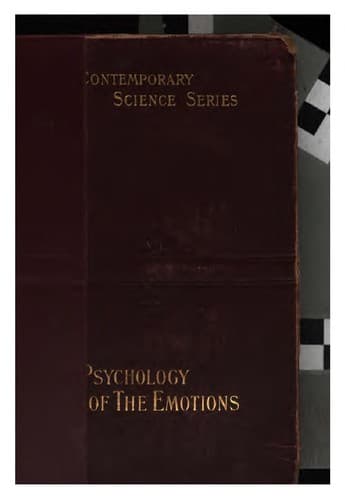
The Psychology of the EmotionsRibot, Th. (Théodule)
Science
The Psychology of the Emotions
Ribot, Th. (Théodule)
Emotions
I add some final remarks on the so-called transformation of pain
into pleasure. Being rarer than its opposite, it presents some
peculiarities to be noted.
Very acute pleasures exhaust quickly—a condition very favourable to
the rapid appearance of pain; I do not see that acute pain ever
changes into pleasure, except perhaps in a few cases to be examined
in the following chapter.
The “transformation” does not take place abruptly, but always by a
gradual transition.
Some have attempted to explain it by habit; but this is so general a
term as to require fresh definition in each individual case. It has
also been said that the painful sensation, being accompanied by
disorganisation and lowering of the vital power, produces, _ipso
facto_, an organic repair, a vital increase, which is the essential
condition of pleasure. But this does not prove that the period of
reintegration coexists with the first impression and imparts to it a
contrary affective sign. The novice in the use of tobacco is at
first incommoded by headache, nausea, etc.; then there follows a
period of repair, but it is not directly connected with the act of
smoking.
It seems to me preferable to admit, with Beaunis, that the agreeable
states we speak of are not simple but complex, consisting of a
certain number of elements. “It may happen that, among the elements
which compose sensation, some are agreeable and some painful; with
habit and exercise the painful element gradually disappears from the
consciousness, and only the agreeable elements of the sensation
remain. In this case there would not really be a transformation of
the pain into pleasure, but an extinction, a disappearance of the
disagreeable elements of the sensation, and a predominance of the
agreeable ones.”[40]
Footnote 40:
Beaunis, _Sensations internes_, pp. 246, 247.
The cause of this change seems to me to lie in the biological
function called adaptation, of whose true nature very little
is known, and which appears to reduce itself to nutritive
modifications. Experiment shows that its efficacy cannot be
depended on: it succeeds in some persons, but fails in others.
CHAPTER IV.
MORBID PLEASURES AND PAINS.
_Utility of the pathological method—Search for a criterion of
the morbid state; abnormal reaction through excess or
defect; apparent disproportion between cause and effect;
chronicity—I. Morbid pleasures, not peculiar to advanced
civilisation—Different attempts at explanation—This state cannot
be explained by normal psychology: it is the rudimentary form of
the suicidal tendency—Classification—Semi-pathological
pleasures: those destructive of the individual, those
destructive of the social order—II. Abnormal pains—Melancholic
type—Whence does the painful state arise in its permanent form?
from an organic disposition? or from a fixed idea?—Examples of
the two cases._
Public-domain text, read in full here on John Shaqi.
Reviews
Reviews
No reviews yet
Be the first to share your thoughts on this work.
Elsewhere in the archive
Join the Discussion
Join the discussion
Sign in to leave a comment or review.
Sign InorCreate an account