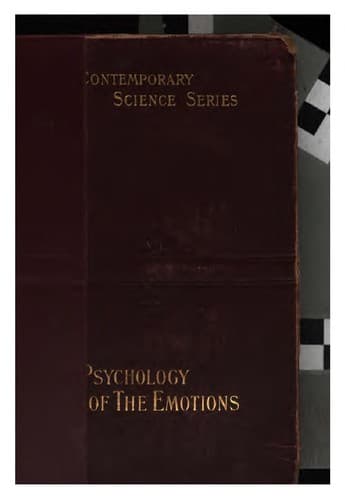
The Psychology of the EmotionsRibot, Th. (Théodule)
Science
The Psychology of the Emotions
Ribot, Th. (Théodule)
Emotions
The title of this chapter may seem paradoxical, pleasure being as a
rule the expression of health, and even of exuberant life, and pain,
by its very definition, a diseased state. It must be admitted that,
for the latter, the expression _abnormal_ would be preferable.
However, the facts we are about to study are not rare, and deserve
separate examination, because the deviations and anomalies of
pleasure and pain serve to make the nature of each better
understood.
Taking our subject, for the first time, on the pathological side, a
proceeding to be applied later on to each of the simple or complex
emotions in turn, certain preliminary remarks are indispensable.
The application of the pathological method to psychology needs no
justification; its efficacy has been proved. The results obtained
are too numerous and too well known to need enumeration. This
method, in fact, has two principal advantages—(1) it is a magnifying
instrument, amplifying the normal phenomenon; hallucination explains
the part played by the image, and hypnotic suggestion throws light
on the suggestion met with in ordinary life; (2) it is a valuable
instrument of analysis. Pathology, it has justly been remarked, is
only physiology out of order, and nothing leads better to the
understanding of a machine than the elimination or the deviation of
one of its wheels. Aphasia produces a decomposition of memory and
its different signs, which the subtlest psychological analysis could
not attempt or even suspect.
The principal difficulty of this method lies in determining the
precise moment when it can be applied. The distinction between the
healthy and the morbid is often extremely difficult to establish. No
doubt there are cases where no hesitation is possible; but there are
also debatable zones lying between the territories of health and
disease. Claude Bernard ventured to write, “What is called the
normal state is purely a conception of the mind, a typical ideal
form entirely disengaged from the thousand divergences among which
the organism is incessantly floating, amid its alternating and
intermittent functions.” If this is the case with regard to bodily
health, we may expect to find it still more so with regard to
mental. The dilemma: Either this man is mad or he is not, is, in
many cases, says Griesinger, meaningless. The psychical organism,
being more complex and less stable than the physical, makes it still
more difficult to fix a norm. Finally, this difficulty attains its
maximum in our subject, because the emotional—the most mobile among
all the forms of psychic life—oscillates incessantly around one
point of equilibrium, always ready to sink too low or rise too high.
As, however, it is necessary to adopt some definite characteristics
which may serve as pathological signs, as criteria for
distinguishing the healthy from the morbid in the emotional order,
we shall accept those proposed by Féré. According to him, an emotion
may be considered as morbid—
Public-domain text, read in full here on John Shaqi.
Reviews
Reviews
No reviews yet
Be the first to share your thoughts on this work.
Elsewhere in the archive
Join the Discussion
Join the discussion
Sign in to leave a comment or review.
Sign InorCreate an account