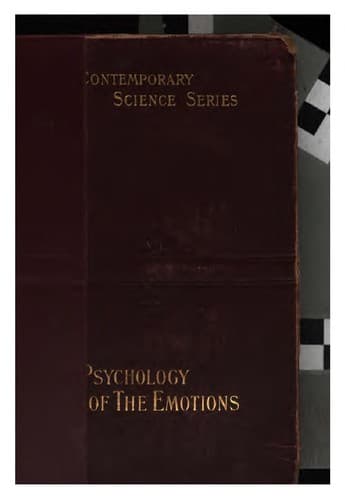
The Psychology of the EmotionsRibot, Th. (Théodule)
Science
The Psychology of the Emotions
Ribot, Th. (Théodule)
Emotions
2. The psychic characteristics consist, in the first place, of an
emotional state varying from apathetic resignation to despair; some
patients are so crushed as to think themselves dead. It has been
noted that, in general, persons of a gloomy disposition are inclined
to melancholia, while those of a cheerful one rather tend towards
mania. In both cases there is an exaggeration of the normal
condition. The intellectual disposition consists in the slackening
of the association of ideas, in indolence of the mind. Ordinarily, a
fixed idea predominates, excluding from the consciousness all that
has no relation to it; thus the hypochondriac thinks only of his
health; the nostalgic, of his country; the religious melancholiac,
of his salvation. Voluntary activity is almost _nil_; aboulia, “the
consciousness of not willing, is the very essence of this disease”
(Schüle). Sometimes there are violent and unexpected reflex
impulses, which are a new proof of the annihilation of the will. To
sum up: while normal sadness has its moments of intermission, the
melancholiac is shut up in his grief as if by an impenetrable wall,
without the slightest fissure through which a ray of joy might reach
him.
Here arises a question we cannot neglect, because it is connected
with one of the principal theses of this work, the fundamental part
played by the feelings. Passive melancholia, being taken as the type
of the painful state under its extreme and permanent form, what is
its origin? There are two possible answers. We may admit that a
physical pain, or a certain representation, engenders a melancholic
disposition, and poisons the affective life. Or we may admit that a
vague and general state of depression and disorganisation becomes
concrete and fixes itself in an idea. On the first supposition the
intellectual state is primary, and the affective state resultant. On
the second the affective state is the first moment, and the
intellectual state results from it.
This problem, rather psychical than practical, has only occupied a
very small number of alienists. Schüle admits the twofold
origin.[50] Sometimes the patient, suffering from a painful and
causeless depression, which he cannot shake off, inquires no
further; but, most frequently, he connects the painful feeling with
some incident in his previous or present life. Sometimes, _much more
rarely_, the haunting idea is the first to appear, and forms the
pivot of the melancholic state and its consequences. Dr. Dumas,[51]
who has devoted a special work to this question, founded on his own
observation, comes to the same conclusions as Schüle. One of his
patients attributed her incurable sadness, in turn, and without
sufficient reason, to her husband, to her son, to expected loss of
work. In others, the melancholy is of intellectual origin: the loss
of fortune, the idea of irrevocable damnation, etc. He is thus led
to admit that a melancholia of organic origin is the most frequent,
one of intellectual origin the rarest.
Public-domain text, read in full here on John Shaqi.
Reviews
Reviews
No reviews yet
Be the first to share your thoughts on this work.
Elsewhere in the archive
Join the Discussion
Join the discussion
Sign in to leave a comment or review.
Sign InorCreate an account