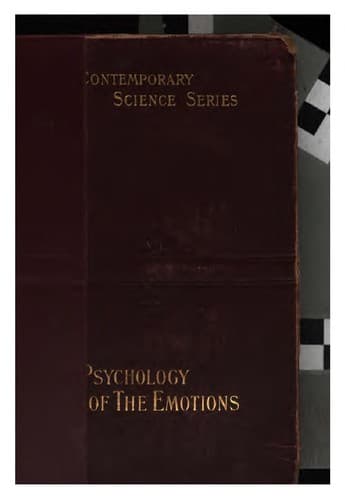
The Psychology of the EmotionsRibot, Th. (Théodule)
Science
The Psychology of the Emotions
Ribot, Th. (Théodule)
Emotions
Bain does not appear to me happy in most of the examples he has
chosen. I quote some of them. The shock produced by surprise—but
surprise is only a mitigated form of fear, and in nearly all cases
instantaneously assumes a painful or pleasurable character. The
state of expectation: “The intense objectivity of one’s looks when
following a race, or a great surgical operation, is not, strictly
speaking, unconsciousness, but a maximum of energy with a minimum of
consciousness. It is rather a mode of indifference—more of an
excitement than an affective state.” Here we may make the same
comment; moreover, there is in expectation a feeling of effort which
soon becomes fatigue, and, in most instances, expectation involves
the anticipation of some event either desired or dreaded.
Those who do not attempt to prove the existence of neutral states by
direct observation deduce them from general principles. Thus Sergi
considers them as the necessary effect of determinate biological
conditions. Pleasure and pain being the two fundamental forms—the
two poles of the life of feeling, there must exist between them a
neutral zone corresponding to a state of perfect adaptation. Pain is
a state of consciousness revealing a conflict of the organism with
exterior forces—a want of adaptation of one to the other; whence a
loss of energy. Pleasure is a state of consciousness which makes it
evident that the reaction of the organism is connected with external
excitations, whence arises, by synergy, a heightening of vital
activity. Indifference is the neutral state of consciousness showing
a perfect adaptation of the organism to constant and variable
intensities—in other words, excitations which neither increase nor
diminish vital activity, but preserve it, produce a state of
equilibrium and appeal to the consciousness neither as pleasure nor
pain.[55] This hypothesis—viz., that at certain moments the sentient
being neither loses nor gains, and that such is the substratum of
the psychic state called neutral, seems to me extremely probable,
but remains no more than a hypothesis.
Footnote 55:
_Psychologie physiologique_, iv., ch. i., pp. 309 _et seq._
(French edition.)
Public-domain text, read in full here on John Shaqi.
Reviews
Reviews
No reviews yet
Be the first to share your thoughts on this work.
Elsewhere in the archive
Join the Discussion
Join the discussion
Sign in to leave a comment or review.
Sign InorCreate an account