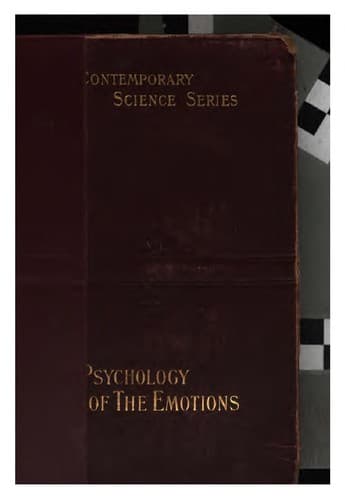
The Psychology of the EmotionsRibot, Th. (Théodule)
Science
The Psychology of the Emotions
Ribot, Th. (Théodule)
Emotions
It is certain that the domain of the indifferent states, if existent
at all, is very scanty. Yet, however skilfully Bouillier may support
his thesis, there is one irrefragable objection to be urged against
it: the testimony of the consciousness, always doubtful, is here
more so than elsewhere. What he proposes to us is, in fact, to
_observe_ ourselves. From the moment when we begin to do this, we no
longer have to deal with the natural consciousness, in its raw
state, but with that somewhat artificial consciousness which is
created by attention. We look, not with our eyes, but through a
microscope; we amplify, we enlarge the phenomenon; and here the
method of enlargement is not to be trusted. It causes certain
subconscious states to cross the threshold of the consciousness; it
makes them pass out of the penumbra into full light, and disposes us
to believe that such is their normal condition. We know that some
individuals, by fixing the attention firmly on some particular part
of the body, can bring about in it a sensation of weight, of
irritation, of arterial pulsation, etc. Do these modifications
always exist, unperceived only so long as the attention is not
directed to them? or does attention produce them by means of an
increased vascular activity, increasing, but not creating? The
latter supposition is the more probable. The hypochondriac who
obstinately and patiently watches the details of his organic life
feels within himself the motion of the vital mechanism which escapes
most men. It would be easy to give other examples, proving that we
must distinguish between consciousness pure and simple and internal
observation, and that it is the less allowable to argue from one to
the other, since in practice the problem is reduced to a difference
of intensity.
This question well deserves to be called, as it has been by J.
Sully, “one of the _cruces_ of psychology.” Those who wish to take
sides in it can only guide their decision by probabilities and
preferences. I am inclined to favour the thesis of indifferent
states. I find it difficult to admit that certain perceptions or
representations, incessantly repeated, imply anything more than the
fact of knowledge. The sight of my furniture, arranged in its usual
order, causes me no appreciable degree of pleasure or displeasure;
or if these exist as infinitesimal quantities, psychology, as Bain
justly says, has no concern with them. Fouillée also points out that
the feeling of indifference is not primary, but due to an
effacement.[57]
Footnote 57:
Fouillée, _Psychologie des idées-forces_, i. 68.
Public-domain text, read in full here on John Shaqi.
Reviews
Reviews
No reviews yet
Be the first to share your thoughts on this work.
Elsewhere in the archive
Join the Discussion
Join the discussion
Sign in to leave a comment or review.
Sign InorCreate an account