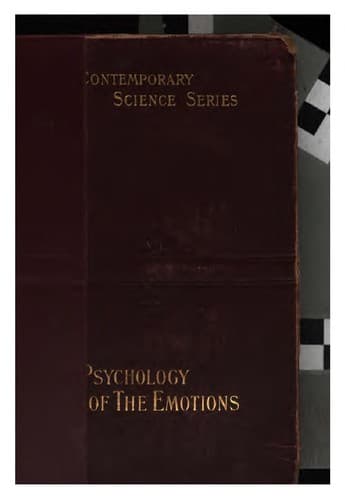
The Psychology of the EmotionsRibot, Th. (Théodule)
Science
The Psychology of the Emotions
Ribot, Th. (Théodule)
Emotions
2. _Vascular reflexes._—Peripheral excitation also has reflex
effects on the vaso-motor system; it produces contraction of the
spinal arteries, of the carotids, and of the cerebral arteries.
Hence the syncope which frequently accompanies acute pain, and the
sleep (the result of anæmia) which has more than once been recorded
in the case of prisoners undergoing torture. This constriction of
the arteries produces a chemical change, a deficit of oxygen and
nutritive elements in the cells of the cortex; the respiration of
the tissues is interfered with, and the distressed state of the
organism is psychologically rendered by pain.
Conversely, the excitations contributing to the wellbeing of the
individual are accompanied by a free transmission of nervous force,
by vaso-motor dilatation, by hyperæmia of the nervous centres, and,
in the motor series, by “aggressive movements,” such as the singing
of birds, the joyous barking of dogs, and other analogous
manifestations in the human subject.
Meynert—vaguely enough, and relying for support on the association
of ideas—has applied his explanation to the case of moral pain. It
would not be difficult to adapt this hypothesis to the different
forms of vexation and sadness; but with a more complicated
mechanism. The point of departure is no longer a perception, but a
representation. The phenomenon is no longer of peripheral, but of
central origin; so that it starts from the brain and returns to it,
or, in psychological terms, begins in a purely intellectual state of
consciousness and ends in a state that is primarily one of feeling.
If, reading by chance a list of deaths in a newspaper, I find, with
no possible opening for doubt, the name of a friend, what takes
place in me is this: the other unknown names pass through my
consciousness like empty words, or a simple visual percept; suddenly
everything is changed; the reflex and vascular movements above
described are produced, then the arrest of the medullary and
cerebral centres, whose expression in consciousness will be grief.
But these reflex actions are only possible if the word read suggests
the recollection of former deaths, that is to say, of a sum of
privations, negations, and checked desires, the result of a mass of
accumulated experiences rising up together and acting, whether
consciously, subconsciously, or unconsciously.
Public-domain text, read in full here on John Shaqi.
Reviews
Reviews
No reviews yet
Be the first to share your thoughts on this work.
Elsewhere in the archive
Join the Discussion
Join the discussion
Sign in to leave a comment or review.
Sign InorCreate an account