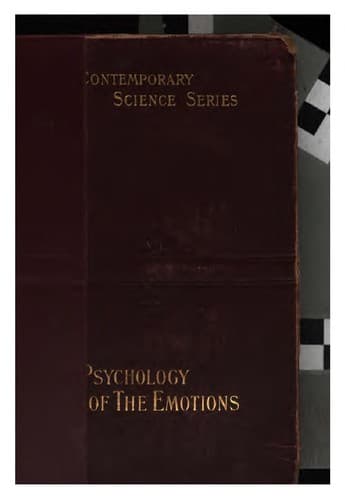
The Psychology of the EmotionsRibot, Th. (Théodule)
Science
The Psychology of the Emotions
Ribot, Th. (Théodule)
Emotions
An English alienist, Clouston, who has published a critical analysis
of this hypothesis of Meynert’s, considers it as the best in the
present state of the science of nervous physiology, although full of
lacunæ, and, after all, rather theoretical than experimental. It is
not in accordance with several facts; _e.g._, in anger, which is a
painful state, there is an afflux of blood, combined with aggressive
movements.[64] On the other hand, it harmonises with a great number
of manifestations observed in mental disease; thus, at the third
stage of general paralysis, a puncture causes a painless reflex
action, because the grey substance, being disorganised, no longer
has any inhibitive power. In the evolution of melancholia, the
patients sometimes at first suffer from purely physical pains
(neuralgia, headache, etc.), which disappear to make way for the
melancholic state, which, in its turn, disappears with the return of
the physical pain. Everyday experience shows that physical and moral
pain cannot coexist in any degree of intensity; a burn may for a
time arrest the progress of melancholy, and we all know what happens
to many persons as soon as they arrive at the dentist’s. It seems as
though the organism had but a limited capacity for either pleasure
or pain, and that neither feeling can exist at the same time in its
double (physical and moral) form.
-----
Footnote 64:
_British Medical Journal_, August 14, 1886, pp. 319 _et seq._ We
shall see, later on, that the mechanism of anger is not so simple
as Clouston seems to admit.
-----
II.
Much has been written on the finality of pleasure and pain, though
two entirely distinct methods of procedure have been adopted.
The first, that of theologians and moralists, is an extrinsic
explanation; pleasure is an attraction, the charm of life; pain is a
vigilant monitor warning us of our disorganisation. They exist in us
by the beneficent grace of Providence or Nature; they have a
transcendental cause.
The second, which has only found complete expression in the
evolutionist school, is an intrinsic explanation. It keeps to the
analysis of facts, and shows that pleasure and pain have their _why_
in the animal’s conditions of existence, and that consequently their
causality is immanent. Thus understood, the problem of _why_ is
pretty nearly identical with that of _how_, mechanism and finality
being very nearly confounded.
Public-domain text, read in full here on John Shaqi.
Reviews
Reviews
No reviews yet
Be the first to share your thoughts on this work.
Elsewhere in the archive
Join the Discussion
Join the discussion
Sign in to leave a comment or review.
Sign InorCreate an account