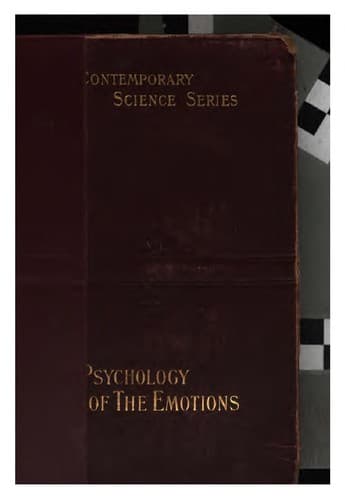
The Psychology of the EmotionsRibot, Th. (Théodule)
Science
The Psychology of the Emotions
Ribot, Th. (Théodule)
Emotions
Herbert Spencer (followed by Grant Allen, Schneider, and others) has
clearly shown that the connection between pleasure and utility, pain
and injury, is an almost necessary relation, having its root in the
nature of things, and that it has been an important factor in the
survival of the fittest. Every animal as a rule persists in actions
which cause it pleasure—that is, in a mode of activity which tends
to its preservation; while it usually avoids what causes it pain,
that being the correlative of injurious actions. The animal has thus
two useful guides in the course of its life, to enable it to survive
and perpetuate its species.
If this rule were without exception,—if pleasure universally
accompanied utility, and _vice versâ_,—it would be sufficient to
state the law of the conditions of existence and nothing more. But
the exceptions to the rule are numerous, and require critical study.
Some can be explained, others seem to me irreducible to any law.
1. Herbert Spencer relieves us of a large number of exceptions,
which are, in fact, only the result of civilisation. Prehistoric
man, according to this author, was well adapted to his environment
and to a predatory life; but when, under pressure of want, the
transition to a sedentary and civilised existence took place, the
human being found itself ill-adapted to its surroundings. The
conditions of social existence have been superposed on those of
natural existence, constituting a new _milieu_, and requiring other
forms of activity. In consequence of this, frequent discordances
have arisen which he has enumerated at great length: the survival of
predatory tendencies difficult to satisfy, the necessity of
repugnant and monotonous labour, excess of labour compensated for by
excess of pleasure, as so frequently happens in great cities,
etc.[65] All these interversions are the work of man, the result of
his irrational struggle against nature, of his will, of his
artificial activities. “In the case of mankind, there has arisen,
and must long continue, a deep and involved derangement of the
natural connections between pleasures and beneficial actions, and
between pains and detrimental actions—a derangement which so
obscures their natural connections that even the reverse connections
are supposed to obtain.” Spencer thinks that a readjustment will
take place in the long run; I leave this consolation—without sharing
it—to the optimists.
-----
Footnote 65:
_Principles of Psychology_, vol. i., §§ 125, 126.
-----
Public-domain text, read in full here on John Shaqi.
Reviews
Reviews
No reviews yet
Be the first to share your thoughts on this work.
Elsewhere in the archive
Join the Discussion
Join the discussion
Sign in to leave a comment or review.
Sign InorCreate an account