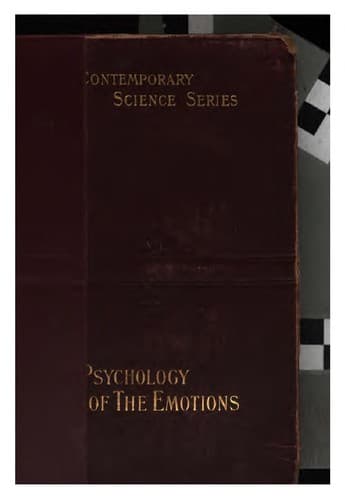
The Psychology of the EmotionsRibot, Th. (Théodule)
Science
The Psychology of the Emotions
Ribot, Th. (Théodule)
Emotions
We have seen, in fact, that Lange expressly confines himself to some
simple emotions, and refuses to venture further. W. James
concentrates his efforts on the “coarse emotions,” the others (“the
subtler emotions”) he only refers to in passing, limiting himself to
some remarks on æsthetic emotion. However, I think it necessary to
treat this subject otherwise than by merely passing it by. Indeed,
the very numerous advocates of the opposite view have maintained
that the physiological theory, while it may be accepted, for want of
a better, for the inferior forms of emotion, becomes insufficient as
we rise to the higher, and that every attempt to apply it to the
superior forms would result in failure.
We must first come to a clear understanding of the value of the
terms inferior and superior, coarse and subtle; they can only denote
degrees in evolution. The inferior or coarse emotions have also been
called “animal,” because common to man and the greater number of
animals. The superior or subtle emotions are properly “human,”
though their germs are to be found in the higher animals.
The first are connected with sensations and perceptions, or with
their immediate representations; they are in close and direct
relation with the preservation of the individual or the species. The
second are connected with images of a less and less concrete
character, or with concepts; they are related in a more vague and
indirect manner to the conditions of existence of the individual or
the species.
We may also say that “inferior” is synonymous with “primary,
simple”; “superior” with “derivative, complex.” How is the
transition from inferior to superior forms produced? For the moment,
it is of no importance to know—it is sufficient to observe that it
has taken place.[70]
-----
Footnote 70:
_Vide infra_, part ii. chap. vii.
-----
Thus, just as, in the intellectual order, there is an ascending
scale, leading from the concrete, successively, to the lower,
medium, and higher forms of abstraction, so in the affective order
there is a scale ascending from fear or anger to the most ideal
emotions. And in the same way as the highest conception retains the
characteristics of the concrete whence it sprang, on pain of being
merely an empty word, so the most ethereal sentiments cannot
entirely lose the characters which constitute them emotions, on pain
of disappearing as such.
I shall not insist on these theoretic remarks; the direct
observation of facts is preferable, and gives a clearer answer.
Public-domain text, read in full here on John Shaqi.
Reviews
Reviews
No reviews yet
Be the first to share your thoughts on this work.
Elsewhere in the archive
Join the Discussion
Join the discussion
Sign in to leave a comment or review.
Sign InorCreate an account