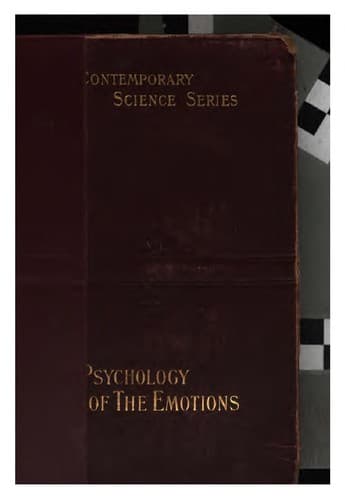
The Psychology of the EmotionsRibot, Th. (Théodule)
Science
The Psychology of the Emotions
Ribot, Th. (Théodule)
Emotions
The superior and truly human forms of emotion are reducible to four
principal groups: the religious, moral, æsthetic, and intellectual
sentiments. Although the somatic characters accompanying each of
these will be noted with the greatest care in the second part of
this work, it will be necessary, even at present, to enumerate the
principal in advance. We must more especially be on our guard
against the common error which insists in seeking emotion where
nothing remains of it save a mere survival and shadow. If, _e.g._,
we take the most intellectualised forms of the religious or the
æsthetic sentiment, we shall have much trouble in recovering the
physiological conditions of its existence. There is nothing
surprising in this, all we have in this case being an abstract or
extract of emotion, a simple mark, an emotional scheme, an affective
substitute equivalent to those intellectual substitutes which take
the place of the concrete. What we must study is true emotion, felt
and expressed, not inadequately recalled to memory, a pale remnant
of what once was an emotion.
1. The religious sentiment is attached—perhaps more than any
other—to physiological conditions, because closely connected with
the instinct of self-preservation, with the saving of the soul,
under whatever form the believer may conceive it. The _intensity_ of
the emotion alone is what concerns us; its quality is a matter for
critical appreciation. We take the observable fact in the rough,
whether legitimate or not. Now, does not the believer, whatever his
degree of culture, whatever his religion, at the moment when he
feels the emotion, tremble, turn pale, exhibit the _sacer horror_,
the overwhelming awe which may end in unconsciousness, the prostrate
attitude? Have not the mystics over and over again described the
violent disturbances which agitate them, the internal tempest which
ravages them, till, calm being re-established, they express
themselves in language frequently recalling that of sexual love? The
designation “hysterical,” bestowed, rightly or wrongly, on many of
them, is based on the physical symptoms described by themselves. And
have not the methods employed to excite, revive, or strengthen
religious emotion, from the wine of the ancient Bacchanals to the
noisy concerts of the Salvation Army, a direct physiological
influence on the organs? What of the action of the rites which are
only the fixed expression of a particular form of belief? and the
miracles which happen in all religions to those who have “the faith
which saves”—do they not take place in the organism? We might fill
many pages with the mere enumeration of the material conditions
surrounding, sustaining, evoking the religious sentiment, as we find
it _in fact_ in contemporary life, or in history. Nothing is more
chimerical than to conceive religious emotion as an unmixed act, a
psychological entity existing in and by itself, independently of its
physiological concomitants.
Public-domain text, read in full here on John Shaqi.
Reviews
Reviews
No reviews yet
Be the first to share your thoughts on this work.
Elsewhere in the archive
Join the Discussion
Join the discussion
Sign in to leave a comment or review.
Sign InorCreate an account