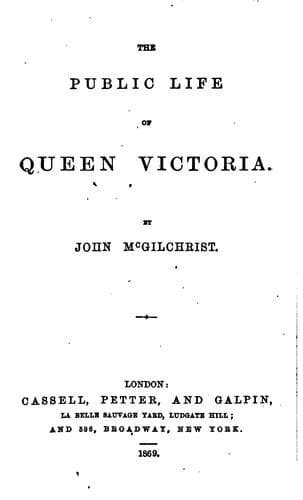
The Public Life of Queen VictoriaMcGilchrist, John
History
The Public Life of Queen Victoria
McGilchrist, John
Victoria, Queen of Great Britain, 1819-1901
Additional Grant by Parliament for the Maintenance and Education of
the Princess--Wise Lessons learned at her Mother's Knees--A Visit to
George IV. at Windsor--Assiduous Pursuit of Knowledge--Accession of
William IV.--Victoria becomes next in succession to the Crown--Regency
Bill--Satisfaction of the good Grandmother at Coburg--Her Death--Joy
of Victoria at the Elevation of her Uncle to the Belgian
Throne--Parliamentary Inquiry into the Progress of her
Education--Satisfactory Report in Response--Presented at Court--Great
Ball on her Twelfth Birthday at St. James's Palace--Court Scandal and
Baseless Rumours--The Duchess of Northumberland appointed
Governess--The Princess and the Poet Southey.
The time had now arrived when, in the opinion, not only of the private
friends of the Duchess of Kent, but of the Ministers of the Crown, it was
held that a more liberal provision should be made for the increasing cost
of the training of the Princess, than the very moderate annual allowance
which the Duchess of Kent had as yet received. This matter was formally
brought before Parliament on the occasion of the Princess attaining her
sixth birthday. Up to this date, and for some little time subsequently to
it, King George IV. seems to have hardly paid the slightest heed to his
niece and ultimate successor. On her fifth birthday, Prince Leopold, who
throughout filled a true father's place, gave a banquet in her honour, at
which most of the members of the English Royal Family, and the Prince
Leiningen, son of the Duchess of Kent and half-brother of Victoria, were
present. On this occasion, the child was much admired for her frankness,
quickness, and talent, but especially for her deep attachment to her
mother. Her mother took occasion to impress upon her the consideration
that such attentions as those which were then shown her were rendered in
the hope that she would cultivate the qualities and graces which alone
could make her a worthy and acceptable ruler of the British empire. "It is
not you," said she, "but your future office and rank which are regarded by
the country; and you must so act as never to bring that office and that
rank into disgrace or disrespect." And when the Duchess took her child to
see for the first time the statue which had just been erected at the top
of Portland Place to her father's memory, she was careful to make her know
and feel that "dear papa's likeness was placed there, not merely because
he was a prince, but because he was a good man, was kind to the poor,
caused little boys and girls to be taught to read and write, helped to get
money from good people to cure the sick, the lame, the blind, the deaf,
and did all he could to make bad people good."
Public-domain text, read in full here on John Shaqi.
Reviews
Reviews
No reviews yet
Be the first to share your thoughts on this work.
Join the Discussion
Join the discussion
Sign in to leave a comment or review.
Sign InorCreate an account