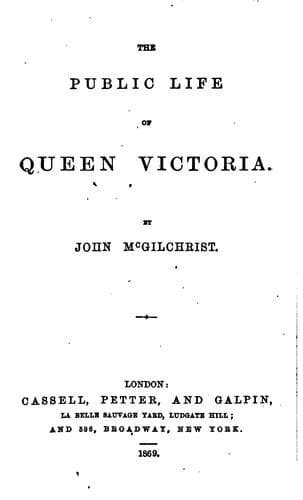
The Public Life of Queen VictoriaMcGilchrist, John
History
The Public Life of Queen Victoria
McGilchrist, John
Victoria, Queen of Great Britain, 1819-1901
ball in her honour, which Queen Victoria has often talked of in later
times, as the scene which of all others made the deepest impression on her
childish imagination. Spite of all this, and of the notorious and profuse
kindness with which the King and Queen Adelaide had always treated her,
many were found to believe that they were jealous of, and meant to slight
her. The truth was, that the Duchess of Northumberland, who, at the
suggestion of the King himself, had been appointed to the high and
important office of governess to the Princess, began to be alarmed at the
consequences of so much festivity and excitement. She objected to her
frequent attendance at drawing-rooms, and also recommended absence from
the fatiguing coronation ceremony.
[Sidenote: THE PRINCESS AND SOUTHEY.]
The selection of this lady for the important office which she filled was a
wise one, and the public judgment approved it. She possessed great
personal attractions, mental powers of unusual range, and the highest
rank. The appointment was by no means a nominal one, or one merely of
state. Her visits to Kensington Palace were constant, and she frequently
remained there all day. On one occasion, while her Grace was instructing
her pupil, Southey called, and was greeted by the Princess and the
_gouvernante_ very warmly. He conversed for some time with the ladies;
first on poetry, then on history. He afterwards used to state with pride,
that the Princess told him that she read his prose and poetical
compositions with equal delight. The "Life of Nelson" especially charmed
her. "That," she said, "is a delightful book indeed; and I am sure I could
read it half a dozen times over." The gossip-mongers also alleged that the
Duchess endeavoured to give a political bias to the education of the
Princess. Some uneasiness was created at this. But when the matter was
properly inquired into, it was ascertained that, neither in the selection
of books to be studied, nor in the remarks made upon their text, was the
slightest party colour given to the education of the royal pupil of the
Duchess. It was while under the care of this lady that the Princess
acquired her well-known admirable horsemanship. To Fozard, the best
riding-master of the day, was entrusted her tuition in riding. She soon
became distinguished by the ease of her carriage, and her truly royal air
and demeanour. This was a common subject of admiring remark by
distinguished foreigners; amongst others, by Count Orloff, to whom, in
1832, the Duchess of Kent gave a splendid banquet. The Princess, after she
was removed from the active care of the Duchess of Northumberland, gave
the best proof of her gratitude and sense of the services she had rendered
her, by keeping up with her Grace a constant epistolary correspondence.
Wherever she went, in the many tours through England which she made while
passing through her teens, she wrote letters to the Duchess describing
whatever interested and instructed her in what she saw. This
Public-domain text, read in full here on John Shaqi.
Reviews
Reviews
No reviews yet
Be the first to share your thoughts on this work.
Join the Discussion
Join the discussion
Sign in to leave a comment or review.
Sign InorCreate an account