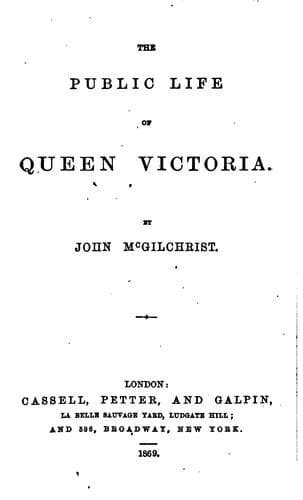
The Public Life of Queen VictoriaMcGilchrist, John
History
The Public Life of Queen Victoria
McGilchrist, John
Victoria, Queen of Great Britain, 1819-1901
true man--a mediaeval "Miller of the Dee"--asked no other recompense than
"only liberty to cut, of scrags and waste wood, what will suffice for my
charring purposes." This was at once granted, along with the freehold of a
snug farm, and an annual and ample allowance of corn from the barns of the
Electors. All was secured to him and his posterity by formal deed, and his
descendants to this day enjoy the privileges so valiantly earned by their
ancestor four centuries ago. From the two princes so rescued, descended
respectively the Ernestine and the Albertine branches of the Saxon house.
The Queen is--as her husband was--twelfth in descent from the little
Prince Ernest, who became the progenitor of the former line.
[Sidenote: THE QUEEN'S SAXON ANCESTORS.]
The parent stock had boasted among other meritorious or distinguished
representatives the names of Conrad the Great, Otho the Rich, Henry the
Illustrious, three Fredericks, dubbed respectively the Serious, the
Warlike, and the Benignant; whilst, as disparaging sets-off, either
demerit or misfortune was indicated, in the instance of other Electors, by
these sobriquets--the Oppressed, the Degenerate, the Severe, and,
strangest of all, Frederick-with-the-Wounded-Cheek. This habit of
designating the successive Electors by their moral or other
peculiarities, or by the incidents or accidents of their careers, was
continued but for a few generations of the Ernestine branch of the
bifurcated line. It contained a Magnanimous Frederick, and a Fiery Ernest,
after whose death, in 1675, this pleasing plan of picturesque designation
no longer meets the eye of the student.
The chivalrous protection which Frederick the Magnanimous--or the Wise, as
he is sometimes also denominated--spread as a buckler over Luther and the
Lutherans cost him his birthright. The bigoted Charles V. diverted, in
1547, the Electoral dignity from the Ernestine to the Albertine branch,
and the fortunes of the house cannot be said to have been fully restored
until the Treaty of Tilsit, in 1807, ratified as its main provisions were
by that of Vienna, seven years later.
Public-domain text, read in full here on John Shaqi.
Reviews
Reviews
No reviews yet
Be the first to share your thoughts on this work.
Join the Discussion
Join the discussion
Sign in to leave a comment or review.
Sign InorCreate an account