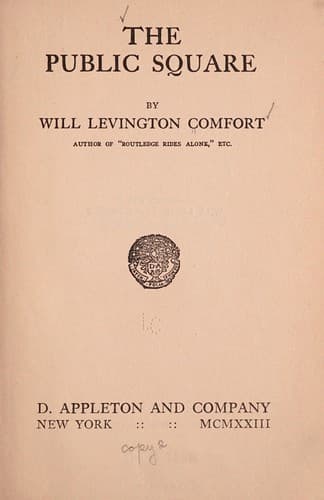
RICHARD COBDEN was twenty-one in 1910, and fresh from his university,
when he took his first job as reader in the editorial office of _The
Public Square_, a weekly magazine of opinion and protest and qualified
patriotism. This was the publication of old John Higgins, at one time
one of the highest-priced editorial writers in New York; but Higgins’
views had become more and more strenuous, instead of mollifying with
the years, the end of which is to publish for one’s self or subside.
Even in _The Public Square_ he found himself under a pull. He wanted
a living out of his magazine, but did not expect to make money. He
occasionally drank himself ill for a day or two. One of his aspirations
was to publish a distinguished short story in each issue, the shorter
the better.
“But there aren’t fifty a year,” he frequently said. “There aren’t
ten, but we get two or three of them.”
Richard Cobden came of a well-established New York family of merchants
and manufacturers. There was no traceable connection, so far as the
family knew, with the English Cobdens, of whom there had been a brave
Richard of free trade and free speech. Dicky’s great-grandfather was
the Richard Cobden who first made the Cobden trowel, hand-forged in a
little shop up Yonkers way, and made it so well that stone masons used
to drive from far in back country to his shop. The Cobdens had made and
dealt in hardware ever since, but the trowel was the Cobden _cachet_.
Dicky was now twenty-four. His eyes were strong and so were his
enthusiasms. These strengths stood him in good stead against the vast
masses of evil typing and the revelations of human frailty contained
in a myriad manuscript attempts. There was a mere screen between his
desk and the desk of John Higgins. One winter afternoon, Dicky was
interrupted by talk between the chief and the office boy:
“That colored guy in the reception room won’t go ’way,” the boy said.
“What guy is that?” Higgins asked.
“The one I told you about two hours ago when you came back from lunch.”
“What does he want?”
“He’s got a story. He says he’ll wait for you.”
“What’s his name?”
“It ain’t a natcherl name. He says the name doesn’t matter--that you
don’t know him, anyway.”
“Tell him to leave his manuscript.”
“He won’t. Every little while he pulls up his sock.”
“Let him sit a bit longer. It’s a regular park bench out there,
anyway----”
It was the dragging sock that attracted Dicky Cobden--a bit of mindless
art on the part of the office boy that somehow aroused the young man
by the dreary manuscript pile. Dicky’s world was now full of people
who thought they had the story of the age; people who wanted to see
the publisher himself; people afraid to trust their manuscripts to the
mails; a world of such, coming up through great tribulation, but only
here and there a dragging sock. He took a chance now and volunteered
to Higgins to clear that bit of seat space in the reception room, if
possible.
Public-domain text, read in full here on John Shaqi.
Reviews
Reviews
No reviews yet
Be the first to share your thoughts on this work.
Join the Discussion
Join the discussion
Sign in to leave a comment or review.
Sign InorCreate an account