“It will interfere with your work session if you lose your temper. Of
course, we’ve got the whole upper floor to start something in, but we
must think of your story.”
“Whose work counts in this outfit?” he demanded.
“Yours, Rufe, by all means. A fine patriotic short story at any price.
But I have a job to look after, and I can’t give them a red-headed
somnambulist to-morrow. No, I’m going to sleep, but I do hope you get
the American flags waving all right in your story.”
“I’ll get you, Pan--for acting like this.”
“You’ve got me, dear, and don’t forget to have the hero come through
with, ‘My country right or wrong.’ No girl can resist that--or editor.
Good night.”
Rufe was rarely rough. He didn’t overtire or over-stimulate himself, so
that his temper could easily break corral; and at its worst this temper
wasn’t a man-eater. Rufe’s nervous system was cushioned in a fine layer
of healthy fat, and therefore didn’t flog itself to madness against
bare bone and sinew. He was merely involved in himself entirely, which
makes any man naïve.
Pidge wasn’t missing any of the petty dramas of her present
experience. When she came home the first time to find that he had
already had dinner, something flew out of her into space in a frantic
search for God. When she realized that he saw nothing but undisturbed
equity in the idea of using her for his own work purposes half
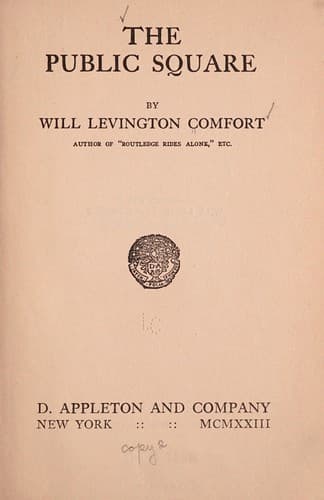
the night, when she was contracted to _The Public Square_ for the
days--another output of herself was loose in the solar system. When she
came to understand that the tens he was earning were mysteriously his
own, and that her ones were theirs--another day, at least, was spoiled
for her in the editorial rooms.
Rufe thought her extremely selfish. So had her father. “Two to one,”
she said. “They’ve got it on me. They’ve got it on all of us. This
is their world.”... She thought of all this bitterness and bickering
taking place in Nagar’s room, which Miss Claes had saved for weeks
for a sort of sanctuary of her own. Mostly she was hurt by the deadly
parallel of this life, with her life in Los Angeles and vicinity. To
cope with this American story-man, she was forced to draw out and
readjust and refurbish the old hateful mechanism that had formed within
her during the nineteen years with her father. She knew how. The
mechanism worked all right, but the sense of the hateful thing resuming
activity within her was far harder to bear than the racket of Rufe’s
typewriter when she was trying to sleep.
Public-domain text, read in full here on John Shaqi.
Reviews
Reviews
No reviews yet
Be the first to share your thoughts on this work.
Elsewhere in the archive
Join the Discussion
Join the discussion
Sign in to leave a comment or review.
Sign InorCreate an account