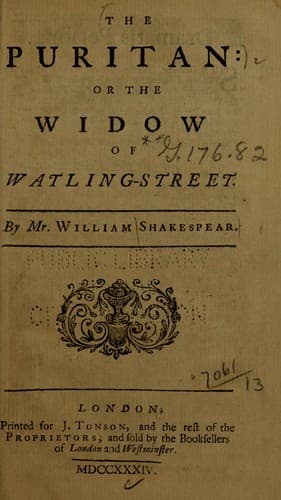
English drama -- Early modern and Elizabethan, 1500-1600; Shakespeare, William, 1564-1616 -- Spurious and doubtful works
FRAILTY.
O Mistress, he may well be called a Corporal now, for his
corps are as dead as a cole Capons.
WIDDOW.
More happiness.
SIR GODFREY.
Sirrah, what’s this to my chain? where’s my chain, knave?
FRAILTY.
Your chain, sir?
SIR GODFREY.
My chain is lost, villain.
FRAILTY.
I would he were hang’d in chains that has it then for me.
Alas, sir, I saw none of your chain, since you were hung
with it your self.
SIR GODFREY.
Out, varlet! it had full three thousand Links.
I have oft told it over at my prayers:
Over and over, full three thousand Links.
FRAILTY.
Had it so, sir: sure, it cannot be lost then; I’ll put you
in that comfort.
SIR GODFREY.
Why, why?
FRAILTY.
Why, if your chain had so many Links, it cannot choose but
come to light.
[Enter Nicholas.]
SIR GODFREY.
Delusion! now, long Nicholas, where’s my chain?
NICHOLAS.
Why, about your Neck, ist not, sir?
SIR GODFREY.
About my neck, Varlet! My chain is lost.
Tis stole away, I’m robbed.
WIDDOW.
Nay, Brother, show your self a man.
NICHOLAS.
Aye, if it be lost or stole, if he would be patient, Mistress,
I could bring him to a Cunning Kinsman of mine that would
fetcht again with a Sesarara.
SIR GODFREY.
Canst thou? I will be patient: say, where dwells he?
NICHOLAS.
Marry, he dwells now, Sir, where he would not dwell, and he
could choose: in the Marshalsea, sir; but he’s a exlent
fellow if he were out; has traveled all the world o’er, he,
and been in the seven and twenty Provinces; why, he would
make it be fetcht, Sir, if twere rid a thousand mile out of
town.
SIR GODFREY.
An admirable fellow: what lies he for?
NICHOLAS.
Why, he did but rob a Steward of ten groats tother Night, as
any man would ha done, and there he lies fort.
SIR GODFREY.
I’ll make his peace: a Trifle! I’ll get his pardon,
Beside a bountiful reward. I’ll about it.
But see the Clerks, the Justice will do much.
I will about it straight: good sister, pardon me.
All will be well, I hope, and turn to good,
The name of Conjurer has laid my blood.
[Exeunt.]
SCENE III. A street.
[Enter two servants with Yeoman Dogson to arrest the Scholar,
George Pye-board.]
PUT.
His Hostess where he lies will trust him no longer: she
has feed me to arrest him; and if you will accompany me,
because I know not of what Nature the Scholar is, whether
desperate or swift, you shall share with me, Servant Raven-
shaw. I have the good Angell to arrest him.
RAVEN.
Troth, I’ll take part with thee, then, Sergeant, not for the
sake of the money so much, as for the hate I bear to a
Scholar: why, Sergeant, tis Natural in us, you know, to
hate Scholars, natural: besides, the will publish our
imperfections, Knaveries, and Convayances upon Scaffolds
and Stages.
PUT.
Aye, and spitefully, too; troth, I have wondered how the
slaves could see into our breasts so much, when our doublets
are buttoned with Pewter.
Public-domain text, read in full here on John Shaqi.
Reviews
Reviews
No reviews yet
Be the first to share your thoughts on this work.
Join the Discussion
Join the discussion
Sign in to leave a comment or review.
Sign InorCreate an account