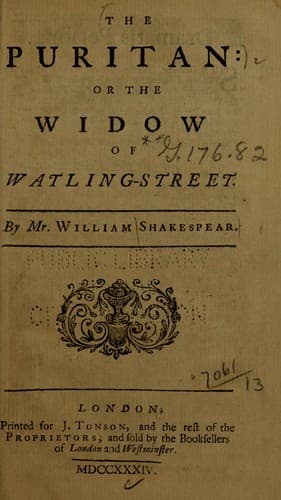
English drama -- Early modern and Elizabethan, 1500-1600; Shakespeare, William, 1564-1616 -- Spurious and doubtful works
WIDOW.
What, he will not? then he’s an exlent fellow, I warrant.
How happy were that woman to be blest with such a Husband!
a man a cunning! how do’s he look, Frailty? very swartly,
I warrant, with black beard, scorcht cheeks, and smoky
eyebrows.
FRAILTY.
Fooh, he’s neither smoke-dried, nor scorcht, nor black, nor
nothing. I tell you, Madame, he looks as fair to see to, as
one of us; I do not think but if you saw him once, you’d
take him to be a Christian.
FRANCES.
So fair, and yet so cunning: that’s to be wonderd at,
Mother.
[Enter Sir Oliver Muck-hill, and Sir Andrew Tip-staff.]
MUCK.
Bless you, sweet Lady.
TIP.
And you, fair Mistress.
[Exit Frailty.]
WIDOW.
Coades? what do you mean, Gentlemen? fie, did I not give
you your answers?
MUCK.
Sweet Lady.
WIDOW.
Well, I will not stick with you now for a kiss.
Daughter, kiss the Gentleman for once.
FRANCES.
Yes, forsooth.
TIP.
I’m proud of such a favour.
WIDOW.
Truly la, sir Oliver, y’are much to blame to come again,
when you know my mind, so well deliverd as a Widdow could
deliver a thing.
MUCK.
But I expect a farther comfort, Lady.
WIDOW.
Why la you now, did I not desire you to put off your suit
quite and clean, when you came to me again? how say you?
did I not?
MUCK.
But the sincere love which my heart bears you—
WIDOW.
Go to, I’ll cut you off: and Sir Oliver, to put you in
comfort a far off, my fortune is read me: I must marry
again.
MUCK.
O blest fortune!
WIDOW.
But not as long as I can choose;—nay, I’ll hold out well.
MUCK.
Yet are my hopes now fairer.
[Enter Frailty.]
FRAILTY.
O Madam, Madam.
WIDOW.
How now, what’s the haste?
[In her ear.]
TIP.
Faith, Mistress Frances, I’ll maintain you gallantly. I’ll
bring you to Court, wean you among the fair society of
ladies, poor Kinswomen of mine, in cloth of silver: beside,
you shall have your Monkey, your Parrot, your Muskrat, and
your pisse, pisse, pisse.
FRANCES.
It will do very well.
WIDOW.
What, dos he mean to conjure here then? how shall I do be
rid of these Knights?—Please you, Gentlemen, to walk a
while ith Garden: go gather a pink, or a Lily-flower.
BOTH.
With all our hearts, Lady, and court us favourd.
[Exit. Within Sir Godfrey.]
SIR GODFREY.
Step in, Nicholas; look, is the coast clear.
NICHOLAS.
Oh, as clear as a Cat’s eye, sir.
SIR GODFREY.
Then enter, Captain Conjurer:—now—how like you your Room,
sir?
[Enter Sir Godfrey, Captain Pye-board, Edmond, Nicholas.]
CAPTAIN.
O, wonderful convenient.
EDMOND.
I can tell you, Captain, simply tho it lies here, tis the
fairest Room in my Mother’s house: as dainty a Room to
Conjure in, me thinks—why, you may bid, I cannot tell how
many devils welcome in’t; my Father has had twenty here at
once.
PYE.
What, devils?
EDMOND.
Devils? no, Deputies, and the wealthiest men he could get.
SIR GODFREY.
Nay, put by your chats now, fall to your business roundly:
the feskewe of the Dial is upon the Chrisse-crosse of Noon,
but oh, hear me, Captain, a qualm comes ore my stomach.
Public-domain text, read in full here on John Shaqi.
Reviews
Reviews
No reviews yet
Be the first to share your thoughts on this work.
Join the Discussion
Join the discussion
Sign in to leave a comment or review.
Sign InorCreate an account