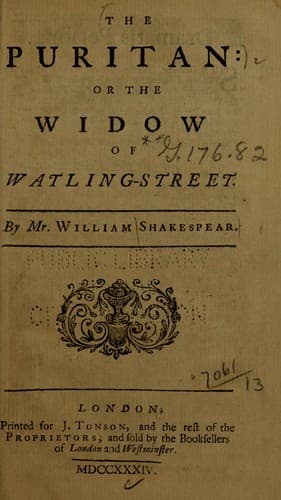
English drama -- Early modern and Elizabethan, 1500-1600; Shakespeare, William, 1564-1616 -- Spurious and doubtful works
MUCK.
Tis too true; yet if the Widdow be not too much besotted on
slights and forgeries, the revelation of their villainies will
make ’em loathsome: and to that end, be it in private to you,
I sent late last night to an honorable personage, to whom I
am much indebted in kindness, as he is to me, and therefore
presume upon the payment of his tongue, and that he will lay
out good words for me: and to speak truth, for such needful
occasions, I only preserve him in bond, and some-times he may
do me more good here in the City by a free word of his mouth,
then if he had paid one half in hand, and took Doomesday for
t’other.
TIP.
In troth, Sir, without soothing be it spoken, you have publisht
much judgment in these few words.
MUCK.
For you know, what such a man utters will be though effectual
and to weighty purpose, and therefore into his mouth we’ll put
the approved theme of their forgeries.
SKIRMISH.
And I’ll maintain it, Knight, if ye’ll be true.
[Enter a servant.]
MUCK.
How now, fellow?
SERVANT.
May it please you, Sir, my Lord is newly lighted from his
Coach.
MUCK.
Is my Lord come already? His honor’s early.
You see he loves me well: up before seven!
Trust me, I have found his night capt at eleven.
There’s good hope yet; come, I’ll relate all to him.
[Exeunt.]
SCENE IV. A street; a church appearing.
[Enter the two Bridegrooms, Captain and Scholar; after them,
Sir Godfrey and Edmond, Widdow changed in apparel, Mistress
Frances led between two Knights, Sir John Pennydub and Moll:
there meets them a Noble man, Sir Oliver Muckhill, and Sir
Andrew Tipstaff.]
NOBLE.
By your leave, Lady.
WIDOW.
My Lord, your honour is most chastely welcome.
NOBLE.
Madam, tho I came now from court, I come now from court, I
come not to flatter you: upon whom can I justly cast this
blot, but upon your own forehead, that know not ink from
milk? such is the blind besotting in the state of an unheaded
woman that’s a widdow. For it is the property of all you that
are widdowes (a hand full excepted) to hate those that honestly
and carefully love you, to the maintenance of credit, state,
and posterity, and strongly to dote on those, that only love
you to undo you: who regard you least are best regarded, who
hate you most are best beloved. And if there be but one man
amongst ten thousand millions of men that is accurst,
disastrous, and evilly planeted, whom Fortune beats most,
whom God hates most, and all Societies esteem least, that man
is sure to be a husband.—Such is the peevish Moon that rules
your bloods. An Impudent fellow best woes you, a flattering
lip best wins you, or in a mirth who talks roughliest is most
sweetest; nor can you distinguish truth from forgeries, mists
from Simplicity: witness those two deceitful monsters that
you have entertaind for bride-grooms.
WIDOW.
Deceitful!
PYE.
All will out.
CAPTAIN.
Sfoot, who has blabd, George? that foolish Nicholas?
Public-domain text, read in full here on John Shaqi.
Reviews
Reviews
No reviews yet
Be the first to share your thoughts on this work.
Join the Discussion
Join the discussion
Sign in to leave a comment or review.
Sign InorCreate an account