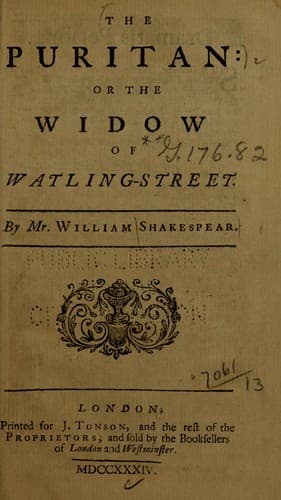
English drama -- Early modern and Elizabethan, 1500-1600; Shakespeare, William, 1564-1616 -- Spurious and doubtful works
PYE.
Oh, fit, fit! excellent.
SKIRMISH.
What, in the name of Conjuring?
PYE.
My memory greets me happily with an admirable subject to
gaze upon: The Lady-Widdow, who of late I saw weeping in
her Garden for the death of her Husband; sure she ’as but a
watrish soul, and half on’t by this time is dropt out of her
Eyes: device well managed may do good upon her: it stands
firm, my first practise shall be there.
SKIRMISH.
You have my voice, George.
PYE.
Sh’as a gray Gull to her Brother, a fool to her only son,
and an Ape to her youngest Daughter.—I overheard ’em
severally, and from their words I’ll derive my device; and
thou, old Peter Skirmish, shall be my second in all slights.
SKIRMISH.
Ne’er doubt me, George Pye-board,—only you must teach me
to conjure.
[Enter Captain Idle, pinioned, and with a guard of Officers
passeth over the Stage.]
PYE.
Puh, I’ll perfect thee, Peter.—How now? what’s he?
SKIRMISH.
Oh George! this sight kills me. Tis my sworn Brother,
Captain Idle.
PYE.
Captain Idle!
SKIRMISH.
Apprehended for some felonious act or other. He has started
out, h’as made a Night on’t, lackt silver. I cannot but
commend his resolution; he would not pawn his Buff-Jerkin.
I would either some of us were employed, or might pitch our
Tents at Usurers’ doors, to kill the slaves as they peep out
at the Wicket.
PYE.
Indeed, those are our ancient Enemies; they keep our money
in their hands, and make us to be hangd for robbing of ’em.
But, come, let’s follow after to the Prison, and know the
Nature of his offence; and what we can steed him in, he
shall be sure of; and I’ll uphold it still, that a charitable
Knave is better then a soothing Puritain.
[Exeunt.]
SCENE III. A Street.
[Enter at one door Corporal Oath, a Vain-glorious fellow;
and at the other, three of the Widdow Puritain’s Servingmen,
Nicholas Saint-Tantlings, Simon Saint-Mary-Overaries, and
Frailty, in black scurvy mourning coats, and Books at their
Girdles, as coming from Church. They meet.]
NICHOLAS.
What, Corporal Oath? I am sorry we have met with you,
next our hearts; you are the man that we are forbidden to
keep company withall. We must not swear I can tell you,
and you have the name for swearing.
SIMON.
Aye, Corporal Oath, I would you would do so much as forsake
us, sir; we cannot abide you, we must not be seen in your
company.
FRAILTY.
There is none of us, I can tell you, but shall be soundly
whipt for swearing.
CORPORAL.
Why, how now, we three? Puritanical Scrape-shoes, Flesh
a good Fridays! a hand.
ALL.
Oh!
CORPORAL.
Why, Nicholas Saint-Tantlings, Simon Saint Mary Ovaries,
ha’s the De’el possest you, that you swear no better? you
half-Christned Catomites, you ungod-mothered Varlets, do’s
the first lesson teach you to be proud, and the second to
be Cocks-combs? proud Cocks-combs! not once to do duty to
a man of Mark!
FRAILTY.
A man of Mark, quatha! I do not think he can shew a Begger’s
Noble.
Public-domain text, read in full here on John Shaqi.
Reviews
Reviews
No reviews yet
Be the first to share your thoughts on this work.
Join the Discussion
Join the discussion
Sign in to leave a comment or review.
Sign InorCreate an account