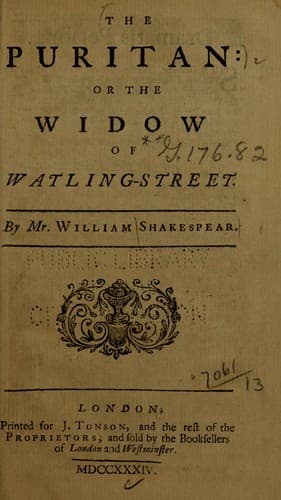
English drama -- Early modern and Elizabethan, 1500-1600; Shakespeare, William, 1564-1616 -- Spurious and doubtful works
PYE.
Why, the better subject to work a scape upon; thou shalt
o’en change clothes with him, and leave him here, and so—
CAPTAIN.
Push, I publish’t him e’en now to my Corporal: he will be
damned, ere he do me so much good; why, I know a more proper,
a more handsome device than that, if the slave would be
sociable. Now, goodman Fleer-face.
NICHOLAS.
Oh, my Cousin begins to speak to me now: I shall be
acquainted with him again, I hope.
SKIRMISH.
Look what ridiculous Raptures take hold of his wrinkles.
PYE.
Then, what say you to this device? a happy one, Captain?
CAPTAIN.
Speak low, George; Prison Rats have wider ears than those
in Malt-lofts.
NICHOLAS.
Cousin, if it lay in my power, as they say—to—do—
CAPTAIN.
Twould do me an exceeding pleasure, indeed, that, but ne’er
talk forder on’t: the fool will be hang’d, ere he do’t.
[To the Corporal.]
CORPORAL.
Pax, I’ll thump ’im to’t.
PYE.
Why, do but try the Fopster, and break it to him bluntly.
CAPTAIN.
And so my disgrace will dwell in his Jaws, and the slave
slaver out our purpose to his Master, for would I were but
as sure on’t as I am sure he will deny to do’t.
NICHOLAS.
I would be heartily glad, Cousin, if any of my friendships,
as they say, might—stand—ah—
PYE.
Why, you see he offers his friendship foolishly to you
already.
CAPTAIN.
Aye, that’s the hell on’t, I would he would offer it wisely.
NICHOLAS.
Verily, and indeed la, Cousin—
CAPTAIN.
I have took note of thy fleers a good while: if thou art
minded to do me good—as thou gapst upon me comfortably,
and giv’st me charitable faces, which indeed is but a
fashion in you all that are Puritains—wilt soon at night
steal me thy Master’s chain?
NICHOLAS.
Oh, I shall swoon!
PYE.
Corporal, he starts already.
CAPTAIN.
I know it to be worth three hundred Crowns, and with the
half of that I can buy my life at a Brokers, at second hand,
which now lies in pawn to th’ Law: if this thou refuse to
do, being easy and nothing dangerous, in that thou art held
in good opinion of thy Master, why tis a palpable Argument
thou holdst my life at no price, and these thy broken and
unioynted offers are but only created in thy lip, now borne,
and now buried, foolish breath only. What, woult do’t? shall
I look for happiness in thy answer?
NICHOLAS.
Steal my Master’s chain, qu’the? no, it shall ne’er be said,
that Nicholas Saint Tantlings committed Bird-lime!
CAPTAIN.
Nay, I told you as much; did I not? tho he be a Puritain, yet
he will be a true man.
NICHOLAS.
Why, Cousin, you know tis written, thou shalt not steal.
CAPTAIN.
Why, and fool, thou shalt love thy Neighbour, and help him in
extremities.
NICHOLAS.
Mass, I think it be, indeed: in what Chapter’s that, Cousin?
CAPTAIN.
Why, in the first of Charity, the 2. Verse.
NICHOLAS.
The first of Charity, quatha! that’s a good jest; there’s no
such Chapter in my book!
CAPTAIN.
No, I knew twas torn out of thy Book, and that makes so little
in thy heart.
Public-domain text, read in full here on John Shaqi.
Reviews
Reviews
No reviews yet
Be the first to share your thoughts on this work.
Join the Discussion
Join the discussion
Sign in to leave a comment or review.
Sign InorCreate an account