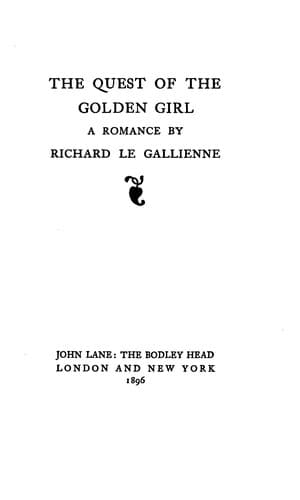
The Quest of the Golden Girl: A RomanceLe Gallienne, Richard
General
The Quest of the Golden Girl: A Romance
Le Gallienne, Richard
Love stories; Man-woman relationships -- Fiction
At this point my companion left me, and I--well, I confess that I
retraced my steps to the common and rambled up that green lane, along
which the romantic schoolmaster used to steal in the moonlight to the
warm arms of his love. How eagerly he had trodden the very turf I was
treading,--we never know at what moment we are treading sacred earth!
But for that old man, I had passed along this path without a thrill.
Had I not but an hour ago stood upon this very common, vainly, so it
seemed, invoking the spirits of passion and romance, and the grim old
common had never made a sign. And now I stood in the very dingle where
they had so often and so wildly met; and it was all gone, quite gone
away for ever. The hours that had seemed so real, the kisses that had
seemed like to last for ever, the vows, the tears, all now as if they
had never been, gone on the four winds, lost in the abysses of time and
space.
And to think of all the thousands and thousands of lovers who had loved
no less wildly and tenderly, made sweet these lanes with their vows,
made green these meadows with their feet; and they, too, all gone,
their bright eyes fallen to dust, their sweet voices for ever put to
silence.
To which I would add, for the benefit of the profane, that I sought in
vain for those broken bottles.
CHAPTER XII
THE TRUTH ABOUT THE GIPSIES
I felt lonely after losing my companion, and I met nobody to take his
place. In fact, for a couple of hours I met nothing worth mentioning,
male or female, with the exception of a gipsy caravan, which I suppose
was both; but it was a poor show. Borrow would have blushed for it. In
fact, it is my humble opinion that the gipsies have been overdone, just
as the Alps have been over-climbed. I have no great desire to see
Switzerland, for I am sure the Alps must be greasy with being climbed.
Besides, the Alps and the gipsies, in common with waterfalls and ruined
castles, belong to the ready-made operatic poetry of the world, from
which the last thrill has long since departed. They are, so to say,
public poetry, the public property of the emotions, and no longer touch
the private heart or stir the private imagination. Our fathers felt so
much about them that there is nothing left for us to feel. They are as
a rose whose fragrance has been exhausted by greedy and indiscriminate
smelling. I would rather find a little Surrey common for myself and
idle about it a summer day, with the other geese and donkeys, than
climb the tallest Alp.
Most gipsies are merely tenth-rate provincial companies, travelling
with and villainously travestying Borrow's great pieces of "Lavengro"
and "Romany Rye." Dirty, ill-looking, scowling men; dirty, slovenly,
and wickedly ugly women; children to match, snarling, filthy little
curs, with a ready beggar's whine on occasion. A gipsy encampment
to-day is little more than a moving slum, a scab of squalor on the fair
face of the countryside.
Public-domain text, read in full here on John Shaqi.
Reviews
Reviews
No reviews yet
Be the first to share your thoughts on this work.
Join the Discussion
Join the discussion
Sign in to leave a comment or review.
Sign InorCreate an account