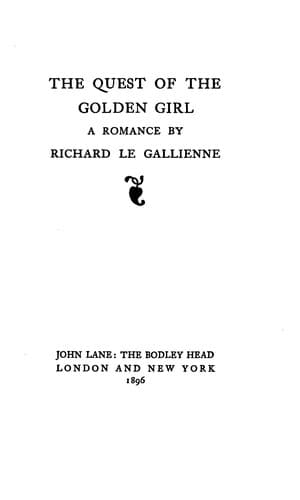
The Quest of the Golden Girl: A RomanceLe Gallienne, Richard
General
The Quest of the Golden Girl: A Romance
Le Gallienne, Richard
Love stories; Man-woman relationships -- Fiction
There is perhaps more to be said for it than that. Indeed, if I were
ever to get married, I am at a loss to know which way I should
choose,--George Muncaster's way or the old merry fashion, with the rice
and the old shoes and the orange-blossom. No doubt the old cheery
publicity is a little embarrassing to the two most concerned, and the
old marriage customs, the singing of the bride and bridegroom to their
nuptial couch, the frank jests, the country horse-play, must have
fretted the souls of many a lover before Shelley, who, it will be
remembered, resented the choral celebrations of his Scotch landlord and
friends by appearing at his bedroom door with a brace of pistols.
How like Shelley! The Scotch landlord meant well, we may be sure, and
a very small pinch of humour, or even mere ordinary humanity, as
distinct from humanitarianism, would have taken in the situation. Of
course Shelley's mind was full of the sanctity of the moment, and
indignant that "the hour for which the years did sigh" should thus be
broken in upon by vulgar revelry; but while we may sympathise with his
view, and admit to the full the sacredness, not to say the solemnity,
of the marriage ceremony, yet it is to be hoped that it still retains a
naturally mirthful side, of which such public merriment is but the
crude expression.
With all its sweet and mystical significance, surely the prevailing
feeling in the hearts of bride and bridegroom is, or should be, that of
happiness,--happiness bubbling and dancing, all sunny ripples from
heart to heart.
Surely they can spare a little of it, just one day's sight of it, to a
less happy world,--a world long since married and done for, and with
little happiness in it save the spectacle of other people's happiness.
It is good for us to see happy people, good for the symbols of
happiness to be carried high amidst us on occasion; for if they serve
no other purpose, they inspire in us the hope that we too may some day
be happy, or remind our discontented hearts that we have been.
If it were only for the sake of those quaint old women for whom life
would be entirely robbed of interest were it not for other people's
weddings and funerals, one feels the public ceremony of marriage a sort
of public duty, the happiness tax, so to say, due to the somewhat
impoverished revenues of public happiness. Other forms of happiness
are taxed; why not marriage?
In a village, particularly, two people who robbed the community of its
perquisites in this respect would be looked upon as "enemies of the
people," and their joint life would begin under a social ban which it
would cost much subsequent hospitality to remove. The dramatic
instinct to which the life of towns is necessarily unfavourable, is
kept alive in the country by the smallness of the stage and the fewness
of the actors. A village is an organism, conscious of its several
parts, as a town is not.
Public-domain text, read in full here on John Shaqi.
Reviews
Reviews
No reviews yet
Be the first to share your thoughts on this work.
Join the Discussion
Join the discussion
Sign in to leave a comment or review.
Sign InorCreate an account