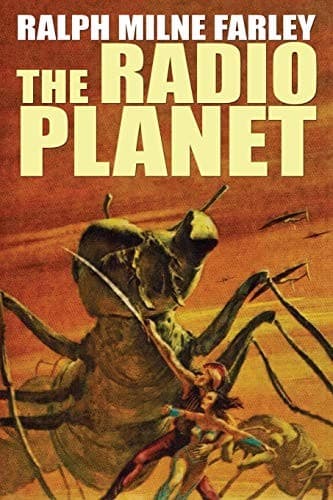
Life on other planets -- Fiction; Science fiction; Venus (Planet) -- Fiction
Twelve months ago he would have been available, for he was then quietly
visiting at my farm, after five earth-years spent on the planet Venus,
where, by the aid of radio, he had led the Cupians to victory over their
oppressors, a human-brained race of gigantic black ants. He had driven
the last ant from the face of continental Poros, and had won and wed the
Princess Lilla, who had borne him a son to occupy the throne of Cupia.
While at my farm Cabot had rigged up a huge radio set and a
matter-transmitting apparatus, with which he had (presumably) shot
himself back to Poros on the night of the big October storm which had
wrecked his installation.
I showed the newspaper item to Mrs. Farley, and lamented on Cabot’s
absence. Her response opened up an entirely new line of thought.
Said she: “Doesn’t the very fact that Mr. Cabot isn’t here suggest to
you that this may be a message, not from Mars, but from him? Or perhaps
from the Princess Lilla, inquiring about him in case he has failed in
his attempted return?”
That had never occurred to me! How stupid!
“What had I better do about it, if anything?” I asked. “Drop Professor
Hammond a line?”
But Mrs. Farley was afraid that I would be taken for a crank.
That evening, when I was over in town, the clerk in the drug store
waylaid me to say that there had been a long-distance phone call for me,
and would I please call a certain Cambridge number.
So, after waiting an interminable time in the stuffy booth with my hands
full of dimes, nickels, and quarters, I finally got my party.
“Mr. Farley?”
“Speaking.”
“This is Professor Kellogg, O. D. Kellogg,” the voice replied.
It was my friend of the Harvard math faculty, the man who had analyzed
the measurements of the streamline projectile in which Myles Cabot had
shot to earth the account of the first part of his adventures on Venus.
Some further adventures Myles had told me in person during his stay on
my farm.
“Professor Hammond thinks that he is getting Mars on the air,” the voice
continued.
“Yes,” I replied. “I judged as much from what I read in this morning’s
paper. But what do _you_ think?”
Kellogg’s reply gave my sluggish mind the second jolt which it had
received that day.
“Well,” he said, “in view of the fact that I am one of the few people
among your readers who take your radio stories seriously, I think that
Hammond is getting Venus. Can you run up here and help me try and
convince him?”
And so it was that I took the early boat next morning for Boston, and
had lunch with the two professors.
As a result of our conference, a small committee of engineers returned
with me to Edgartown that evening for the purpose of trying to repair
the wrecked radio set which Myles Cabot had left on my farm.
They utterly failed to comprehend the matter-transmitting apparatus, and
so—after the fallen tower had been reerected and the rubbish cleared
away—they had devoted their attention to the restoration of the
conversational part of the set.
Public-domain text, read in full here on John Shaqi.
Reviews
Reviews
No reviews yet
Be the first to share your thoughts on this work.
Join the Discussion
Join the discussion
Sign in to leave a comment or review.
Sign InorCreate an account