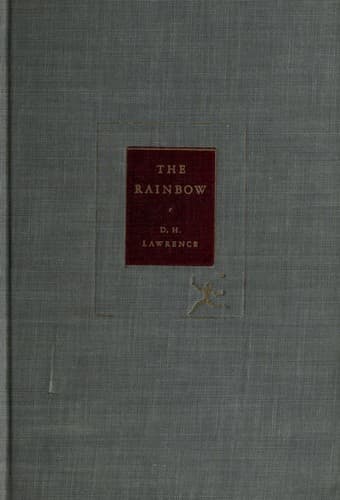
Domestic fiction; Family -- England -- Midlands -- Fiction; Midlands (England) -- Fiction
She, desolate again as she had been when she was a child, went away and
sobbed. She did not care, she did not care whether the water had turned
to wine or not. Let him believe it if he wanted to. But she knew she
had won. And an ashy desolation came over her.
They were ashenly miserable for some time. Then the life began to come
back. He was nothing if not dogged. He thought again of the chapter of
St. John. There was a great biting pang. “But thou hast kept the good
wine until now.” “The best wine!” The young man’s heart responded in a
craving, in a triumph, although the knowledge that it was not true in
fact bit at him like a weasel in his heart. Which was stronger, the
pain of the denial, or the desire for affirmation? He was stubborn in
spirit, and abode by his desire. But he would not any more affirm the
miracles as true.
Very well, it was not true, the water had not turned into wine. The
water had not turned into wine. But for all that he would live in his
soul as if the water _had_ turned into wine. For truth of fact, it had
not. But for his soul, it had.
“Whether it turned into wine or whether it didn’t,” he said, “it
doesn’t bother me. I take it for what it is.”
“And _what_ is it?” she asked, quickly, hopefully.
“It’s the Bible,” he said.
That answer enraged her, and she despised him. She did not actively
question the Bible herself. But he drove her to contempt.
And yet he did not care about the Bible, the written letter. Although
he could not satisfy her, yet she knew of herself that he had something
real. He was not a dogmatist. He did not believe in _fact_ that the
water turned into wine. He did not want to make a fact out of it.
Indeed, his attitude was without criticism. It was purely individual.
He took that which was of value to him from the Written Word, he added
to his spirit. His mind he let sleep.
And she was bitter against him, that he let his mind sleep. That which
was human, belonged to mankind, he would not exert. He cared only for
himself. He was no Christian. Above all, Christ had asserted the
brotherhood of man.
She, almost against herself, clung to the worship of the human
knowledge. Man must die in the body, but in his knowledge he was
immortal. Such, somewhere, was her belief, quite obscure and
unformulated. She believed in the omnipotence of the human mind.
He, on the other hand, blind as a subterranean thing, just ignored the
human mind and ran after his own dark-souled desires, following his own
tunnelling nose. She felt often she must suffocate. And she fought him
off.
Then he, knowing he was blind, fought madly back again, frantic in
sensual fear. He did foolish things. He asserted himself on his rights,
he arrogated the old position of master of the house.
“You’ve a right to do as I want,” he cried.
“Fool!” she answered. “Fool!”
“I’ll let you know who’s master,” he cried.
Public-domain text, read in full here on John Shaqi.
Reviews
Reviews
No reviews yet
Be the first to share your thoughts on this work.
Elsewhere in the archive
Join the Discussion
Join the discussion
Sign in to leave a comment or review.
Sign InorCreate an account