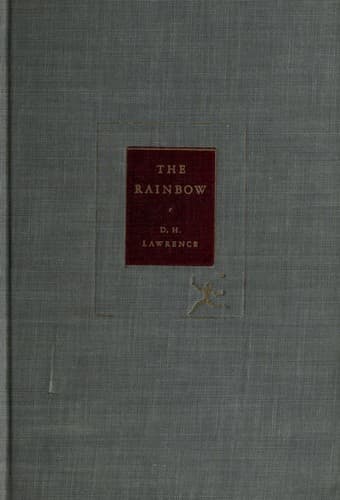
Domestic fiction; Family -- England -- Midlands -- Fiction; Midlands (England) -- Fiction
Whereas when, at twenty-six, he found himself father of four children,
with a wife who lived intrinsically like the ruddiest lilies of the
field, he let the weight of responsibility press on him and drag him.
It was then that his child Ursula strove to be with him. She was with
him, even as a baby of four, when he was irritable and shouted and made
the household unhappy. She suffered from his shouting, but somehow it
was not really him. She wanted it to be over, she wanted to resume her
normal connection with him. When he was disagreeable, the child echoed
to the crying of some need in him, and she responded blindly. Her heart
followed him as if he had some tie with her, and some love which he
could not deliver. Her heart followed him persistently, in its love.
But there was the dim, childish sense of her own smallness and
inadequacy, a fatal sense of worthlessness. She could not do anything,
she was not enough. She could not be important to him. This knowledge
deadened her from the first.
Still she set towards him like a quivering needle. All her life was
directed by her awareness of him, her wakefulness to his being. And she
was against her mother.
Her father was the dawn wherein her consciousness woke up. But for him,
she might have gone on like the other children, Gudrun and Theresa and
Catherine, one with the flowers and insects and playthings, having no
existence apart from the concrete object of her attention. But her
father came too near to her. The clasp of his hands and the power of
his breast woke her up almost in pain from the transient
unconsciousness of childhood. Wide-eyed, unseeing, she was awake before
she knew how to see. She was wakened too soon. Too soon the call had
come to her, when she was a small baby, and her father held her close
to his breast, her sleep-living heart was beaten into wakefulness by
the striving of his bigger heart, by his clasping her to his body for
love and for fulfilment, asking as a magnet must always ask. From her
the response had struggled dimly, vaguely into being.
The children were dressed roughly for the country. When she was little,
Ursula pattered about in little wooden clogs, a blue overall over her
thick red dress, a red shawl crossed on her breast and tied behind
again. So she ran with her father to the garden.
The household rose early. He was out digging by six o’clock in the
morning, he went to his work at half-past eight. And Ursula was usually
in the garden with him, though not near at hand.
Public-domain text, read in full here on John Shaqi.
Reviews
Reviews
No reviews yet
Be the first to share your thoughts on this work.
Elsewhere in the archive
Join the Discussion
Join the discussion
Sign in to leave a comment or review.
Sign InorCreate an account