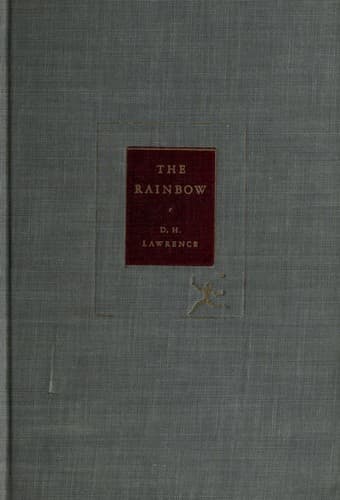
Domestic fiction; Family -- England -- Midlands -- Fiction; Midlands (England) -- Fiction
So, the old duality of life, wherein there had been a weekday world of
people and trains and duties and reports, and besides that a Sunday
world of absolute truth and living mystery, of walking upon the waters
and being blinded by the face of the Lord, of following the pillar of
cloud across the desert and watching the bush that crackled yet did not
burn away, this old, unquestioned duality suddenly was found to be
broken apart. The weekday world had triumphed over the Sunday world.
The Sunday world was not real, or at least, not actual. And one lived
by action.
Only the weekday world mattered. She herself, Ursula Brangwen, must
know how to take the weekday life. Her body must be a weekday body,
held in the world’s estimate. Her soul must have a weekday value, known
according to the world’s knowledge.
Well, then, there was a weekday life to live, of action and deeds. And
so there was a necessity to choose one’s action and one’s deeds. One
was responsible to the world for what one did.
Nay, one was more than responsible to the world. One was responsible to
oneself. There was some puzzling, tormenting residue of the Sunday
world within her, some persistent Sunday self, which insisted upon a
relationship with the now shed-away vision world. How could one keep up
a relationship with that which one denied? Her task was now to learn
the week-day life.
How to act, that was the question? Whither to go, how to become
oneself? One was not oneself, one was merely a half-stated question.
How to become oneself, how to know the question and the answer of
oneself, when one was merely an unfixed something—nothing, blowing
about like the winds of heaven, undefined, unstated.
She turned to the visions, which had spoken far-off words that ran
along the blood like ripples of an unseen wind, she heard the words
again, she denied the vision, for she must be a weekday person, to whom
visions were not true, and she demanded only the weekday meaning of the
words.
There _were_ words spoken by the vision: and words must have a weekday
meaning, since words were weekday stuff. Let them speak now: let them
bespeak themselves in weekday terms. The vision should translate itself
into weekday terms.
“Sell all thou hast, and give to the poor,” she heard on Sunday
morning. That was plain enough, plain enough for Monday morning too. As
she went down the hill to the station, going to school, she took the
saying with her.
“Sell all thou hast, and give to the poor.”
Did she want to do that? Did she want to sell her pearl-backed brush
and mirror, her silver candlestick, her pendant, her lovely little
necklace, and go dressed in drab like the Wherrys: the unlovely
uncombed Wherrys, who were the “poor” to her? She did not.
Public-domain text, read in full here on John Shaqi.
Reviews
Reviews
No reviews yet
Be the first to share your thoughts on this work.
Elsewhere in the archive
Join the Discussion
Join the discussion
Sign in to leave a comment or review.
Sign InorCreate an account