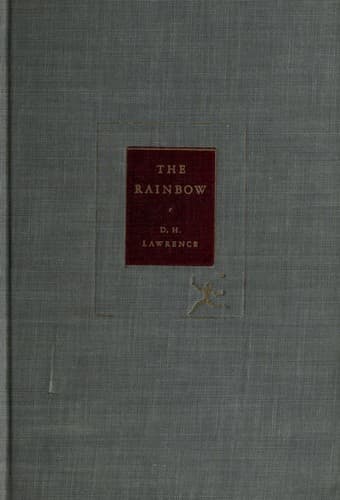
Domestic fiction; Family -- England -- Midlands -- Fiction; Midlands (England) -- Fiction
She laid hold of him at once for her dreams. Here was one such as those
Sons of God who saw the daughters of men, that they were fair. He was
no son of Adam. Adam was servile. Had not Adam been driven cringing out
of his native place, had not the human race been a beggar ever since,
seeking its own being? But Anton Skrebensky could not beg. He was in
possession of himself, of that, and no more. Other people could not
really give him anything nor take anything from him. His soul stood
alone.
She knew that her mother and father acknowledged him. The house was
changed. There had been a visit paid to the house. Once three angels
stood in Abraham’s doorway, and greeted him, and stayed and ate with
him, leaving his household enriched for ever when they went.
The next day she went down to the Marsh according to invitation. The
two men were not come home. Then, looking through the window, she saw
the dogcart drive up, and Skrebensky leapt down. She saw him draw
himself together, jump, laugh to her uncle, who was driving, then come
towards her to the house. He was so spontaneous and revealed in his
movements. He was isolated within his own clear, fine atmosphere, and
as still as if fated.
His resting in his own fate gave him an appearance of indolence, almost
of languor: he made no exuberant movement. When he sat down, he seemed
to go loose, languid.
“We are a little late,” he said.
“Where have you been?”
“We went to Derby to see a friend of my father’s.”
“Who?”
It was an adventure to her to put direct questions and get plain
answers. She knew she might do it with this man.
“Why, he is a clergyman too—he is my guardian—one of them.”
Ursula knew that Skrebensky was an orphan.
“Where is really your home now?” she asked.
“My home?—I wonder. I am very fond of my colonel—Colonel Hepburn: then
there are my aunts: but my real home, I suppose, is the army.”
“Do you like being on your own?”
His clear, greenish-grey eyes rested on her a moment, and, as he
considered, he did not see her.
“I suppose so,” he said. “You see my father—well, he was never
acclimatized here. He wanted—I don’t know what he wanted—but it was a
strain. And my mother—I always knew she was too good to me. I could
feel her being too good to me—my mother! Then I went away to school so
early. And I must say, the outside world was always more naturally a
home to me than the vicarage—I don’t know why.”
“Do you feel like a bird blown out of its own latitude?” she asked,
using a phrase she had met.
“No, no. I find everything very much as I like it.”
He seemed more and more to give her a sense of the vast world, a sense
of distances and large masses of humanity. It drew her as a scent draws
a bee from afar. But also it hurt her.
It was summer, and she wore cotton frocks. The third time he saw her
she had on a dress with fine blue-and-white stripes, with a white
collar, and a large white hat. It suited her golden, warm complexion.
Public-domain text, read in full here on John Shaqi.
Reviews
Reviews
No reviews yet
Be the first to share your thoughts on this work.
Elsewhere in the archive
Join the Discussion
Join the discussion
Sign in to leave a comment or review.
Sign InorCreate an account