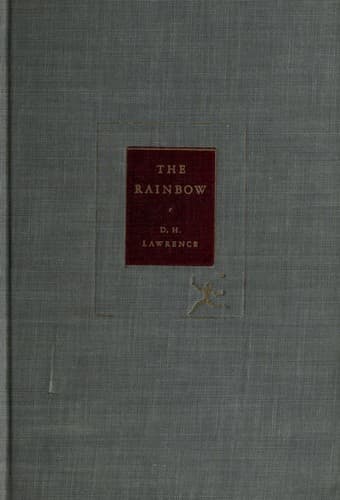
Domestic fiction; Family -- England -- Midlands -- Fiction; Midlands (England) -- Fiction
When finally she took her way home, it was sunset red across the west.
She did not know why she was going home. There was nothing for her
there. She had, true, only to pretend to be normal. There was nobody
she could speak to, nowhere to go for escape. But she must keep on,
under this red sunset, alone, knowing the horror in humanity, that
would destroy her, and with which she was at war. Yet it had to be so.
In the morning again she must go to school. She got up and went without
murmuring even to herself. She was in the hands of some bigger,
stronger, coarser will.
School was fairly quiet. But she could feel the class watching her,
ready to spring on her. Her instinct was aware of the class instinct to
catch her if she were weak. But she kept cold and was guarded.
Williams was absent from school. In the middle of the morning there was
a knock at the door: someone wanted the headmaster. Mr. Harby went out,
heavily, angrily, nervously. He was afraid of irate parents. After a
moment in the passage, he came again into school.
“Sturgess,” he called to one of his larger boys. “Stand in front of the
class and write down the name of anyone who speaks. Will you come this
way, Miss Brangwen.”
He seemed vindictively to seize upon her.
Ursula followed him, and found in the lobby a thin woman with a whitish
skin, not ill-dressed in a grey costume and a purple hat.
“I called about Vernon,” said the woman, speaking in a refined accent.
There was about the woman altogether an appearance of refinement and of
cleanliness, curiously contradicted by her half beggar’s deportment,
and a sense of her being unpleasant to touch, like something going bad
inside. She was neither a lady nor an ordinary working man’s wife, but
a creature separate from society. By her dress she was not poor.
Ursula knew at once that she was Williams’ mother, and that he was
Vernon. She remembered that he was always clean, and well-dressed, in a
sailor suit. And he had this same peculiar, half transparent
unwholesomeness, rather like a corpse.
“I wasn’t able to send him to school to-day,” continued the woman, with
a false grace of manner. “He came home last night _so_ ill—he was
violently sick—I thought I should have to send for the doctor.—You know
he has a weak heart.”
The woman looked at Ursula with her pale, dead eyes.
“No,” replied the girl, “I did not know.”
She stood still with repulsion and uncertainty. Mr. Harby, large and
male, with his overhanging moustache, stood by with a slight, ugly
smile at the corner of his eyes. The woman went on insidiously, not
quite human:
“Oh, yes, he has had heart disease ever since he was a child. That is
why he isn’t very regular at school. And it is very bad to beat him. He
was awfully ill this morning—I shall call on the doctor as I go back.”
“Who is staying with him now, then?” put in the deep voice of the
schoolmaster, cunningly.
Public-domain text, read in full here on John Shaqi.
Reviews
Reviews
No reviews yet
Be the first to share your thoughts on this work.
Elsewhere in the archive
Join the Discussion
Join the discussion
Sign in to leave a comment or review.
Sign InorCreate an account