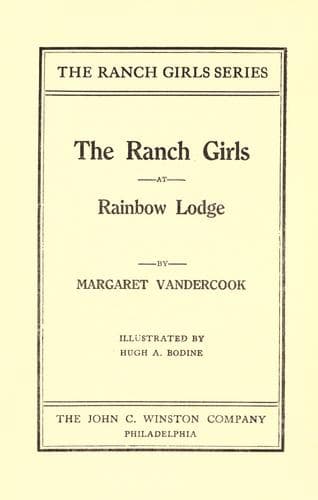
The Ranch Girls at Rainbow LodgeVandercook, Margaret
General
The Ranch Girls at Rainbow Lodge
Vandercook, Margaret
Ranch life -- Juvenile fiction; Western stories; Young women -- Juvenile fiction
The Indian village was not so very far from the Simpson ranch, in the
way that Western people count distances. Pretty soon the automobile
party saw circles of smoke arising in the air. On a rounded green slope
of the prairie near a little river was a collection of wigwams and
huts.
"I am jolly glad some of the Indians still live in tepees." Frank
confided to Jack. "I was dreadfully afraid that your up-to-date,
government-cared-for 'Injun,' was going to be just like everybody else
and wear store clothes and live in a regular American house, and then
what could I have to tell my people when I go back home to England?"
Frank was staring ahead of him and for the first time since his first
meeting with Jack, he had entirely gotten over his British shyness.
"Don't you worry," Jack answered gaily. "I am awfully glad you have come
with us. Now you'll see the real thing! Of course, some of our Indians
have been educated and civilized, but I am sure many of them are just
the same in their hearts as they used to be, and would lead the same
kind of lives if they had a chance. I can tell you they try to get their
revenge, if you make them angry!"
There were a number of lean horses grazing near the village. The streets
were dreadfully dirty and overflowing with thin, brown children rolling
in the sand and playing with wolfish, half-fed dogs. In front of the
rude huts or the cone-shaped tents with sheafs of poles extending
through their tops, were big Indian men, as solemn, silent and
terrifying as though they had been Indian war chiefs meditating on some
terrible massacre. Most of them wore fringed leather trousers and had
bright blankets wrapped about them. They were calmly smoking, and only
barely turned their narrow eyes to glance at the automobile, as it
passed by them.
Near most of the dwellings were outdoor fires, with pots boiling above
them, as few of the Indians can make up their minds to use kitchen
stoves instead of their familiar campfires. Old women sat near the
fires, stringing bright beads, or weaving mats. Some of them were making
Indian blankets on rude frames of logs, set upright some feet apart, and
strung with cords, like an old-fashioned wooden loom.
The chauffeur slowed down and the girls and boys could see that the
Indians were talking about their party, making queer sounds and signs to
one another. The women rushed out with trinkets to sell, the children
sat cross-legged in the dirt, the dogs barked and young women with
babies on their backs crept out of their doors. But among the whole
number, there was no sign of Laska or Josef.
Public-domain text, read in full here on John Shaqi.
Reviews
Reviews
No reviews yet
Be the first to share your thoughts on this work.
Join the Discussion
Join the discussion
Sign in to leave a comment or review.
Sign InorCreate an account