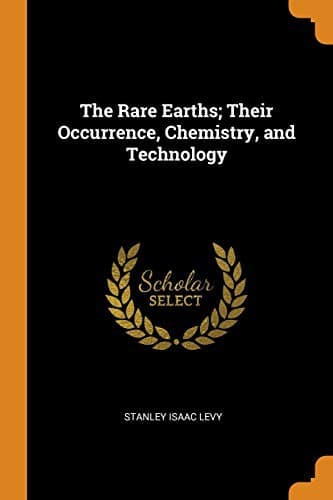
The Rare Earths: Their Occurrence, Chemistry, and TechnologyLevy, Stanley Isaac
Science
The Rare Earths: Their Occurrence, Chemistry, and Technology
Levy, Stanley Isaac
Rare earths
The _carbide_, TiC, was prepared by Moissan by heating the oxide with
carbon in the electric furnace; any excess of carbon separates on
cooling as graphite. It has the density 4·25, and resembles the fused
element in appearance. It dissolves in nitric but not in hydrochloric
acid.
_Titanium tetrafluoride_, TiF₄, is obtained by the action of fluorine on
the element or the carbide, and by the action of anhydrous hydrofluoric
acid on the element or the tetrachloride. It is a white powder, and
boils at 284°; it is very hygroscopic, and dissolves easily in alcohol
and water, showing little tendency to form basic salts. From the
concentrated aqueous solution it separates as the dihydrate, TiF₄,2H₂O;
basic salts are obtained only by repeated evaporation with water. The
anhydrous compound forms additive products with ammonia and with
pyridine.
With aqueous hydrofluoric acid it forms the complex H₂TiF₆, as shown by
conductivity measurements, and the fact that only a slow and incomplete
precipitation of the hydroxide is effected by addition of ammonia. The
solution dissolves metallic oxides and carbonates, forming
_titanofluorides_, which are for the most part isomorphous with the
corresponding silicofluorides, stannofluorides, and zirconofluorides.
They are very stable crystalline salts, of the general formula R´₂TiF₆;
many salts of the types R´´TiF₆, R´₃TiF₇, etc., have been prepared. The
most important is the potassium salt, K₂TiF₆, which crystallises from
acid solutions in monoclinic tablets; from aqueous solution it separates
as the monohydrate, K₂TiF₆,H₂O, isomorphous with the compounds
K₂CbOF₅,H₂O and K₂WO₂F₄,H₂O. The hydrate loses its water at 100°, and
melts at a white heat without decomposition. It is moderately soluble in
hot, very sparingly soluble in cold water, and hence is readily
recrystallised.
The _tetrachloride_, TiCl₄, is important, on account of its low
boiling-point, for the separation and purification of titanium
compounds. In physical as well as chemical properties, it resembles the
chloride of a non-metallic element rather than a normal salt, and is
distinguished by the ease with which it combines or reacts with the most
widely differing organic compounds. It is prepared by the action of
chlorine upon the element, the carbide, or a mixture of the dioxide with
carbon, and by the action of chloroform or carbon tetrachloride upon the
dioxide at a bright red heat. It is a colourless, transparent liquid, of
density 1·76 at 0°; it freezes at -23°, and boils at 136° under
atmospheric pressure. In moist air it fumes excessively, yielding
hydrogen chloride by hydrolysis: TiCl₄ + H₂O = TiOCl₂ + 2HCl, and is
decomposed by water with separation of the hydrated oxide. If the
compound be added slowly to a large quantity of cold water, and the
clear solution warmed, the oxide formed by hydrolysis remains in
colloidal solution.
Public-domain text, read in full here on John Shaqi.
Reviews
Reviews
No reviews yet
Be the first to share your thoughts on this work.
Elsewhere in the archive
Join the Discussion
Join the discussion
Sign in to leave a comment or review.
Sign InorCreate an account