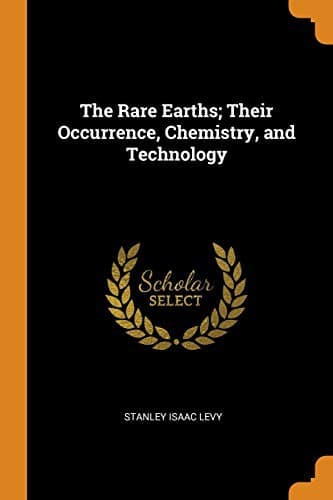
The Rare Earths: Their Occurrence, Chemistry, and TechnologyLevy, Stanley Isaac
Science
The Rare Earths: Their Occurrence, Chemistry, and Technology
Levy, Stanley Isaac
Rare earths
The chloride dissolves in fuming hydrochloric acid, forming a deep
yellow solution, which becomes colourless when diluted. The solution
appears to contain the unstable complex acid H₂TiCl₆, or its ions; by
addition of ammonia, or organic bases, salts of the type (NH₄)₂TiCl₆ can
be obtained as yellow crystalline solids. An interesting property of the
chloride is its ability to form stable additive compounds with the
chlorides of negative elements. A long series of these are known, of
which the compounds TiCl₄,PCl₃, TiCl₄,PCl₅, TiCl₄,POCl₃, and
TiCl₄,2POCl₃ may be considered examples; for the most part, they can be
distilled without decomposition. A very long series of compounds, partly
additive and partly condensation products, with all kinds of organic
substances, is also known.
A series of _oxychlorides_, or _basic chlorides_, TiCl₃(OH), TiCl₂(OH)₂,
and TiCl(OH)₃, has been obtained by addition of hydrochloric acid, in
certain quantities and concentrations, to the chloride; they are
amorphous solids, of which little is known.
The _tetrabromide_, TiBr₄, is a yellow crystalline solid, melting at 39°
and boiling at 230°. Its solutions in concentrated hydrobromic acid are
of a blood-red colour, and by treatment with ammonia and organic bases
yield deep red crystalline salts of the type (NH₄)₂TiBr₆. The
_tetraiodide_, TiI₄, is a reddish-brown metallic-looking solid, melting
at 150°, and boiling at 360°; no complex salts are known.
_The sulphates._--Many compounds of doubtful composition and
individuality have been described as titanium sulphates, but relatively
little is known with certainty of this class of derivatives. The most
stable seems to be the _titanyl sulphate_, TiOSO₄, obtained as a white
powder, which is slowly hydrolysed by water, by evaporating a solution
of the dioxide in concentrated sulphuric acid. Under suitable
conditions, _e.g._ when separated from acid or alcoholic solutions, it
is said to form hydrated compounds; the mono-, di- and penta-hydrate
have been described. When solutions of this compound in concentrated
sulphuric acid are treated with concentrated aqueous solutions
of alkali sulphates, salts of the formulæ (NH₄)₂TiO(SO₄)₂,H₂O and
K₄(TiO)₃(SO₄)₅,10H₂O, are obtained. By treating solutions of the dioxide
in a large excess of concentrated acid with solutions of calcium or
strontium sulphate in sulphuric acid, salts of the type R´´Ti(SO₄)₃ are
obtained; the barium salt has the formula 3Ti(SO₄)₂,2BaSO₄. All these
compounds are rapidly hydrolysed by water.
_Phosphoric Acid Derivatives._--Solutions of titanium compounds are
completely precipitated by the addition of phosphoric acid, or soluble
phosphates, even in presence of a large excess of mineral acid, but the
composition of the precipitate obtained is unknown. By heating the oxide
with orthophosphoric acid, a crystalline compound, TiO₂,P₂O₅, is
obtained, and various alkali double phosphates may be prepared by
suitable fusions.
Public-domain text, read in full here on John Shaqi.
Reviews
Reviews
No reviews yet
Be the first to share your thoughts on this work.
Elsewhere in the archive
Join the Discussion
Join the discussion
Sign in to leave a comment or review.
Sign InorCreate an account