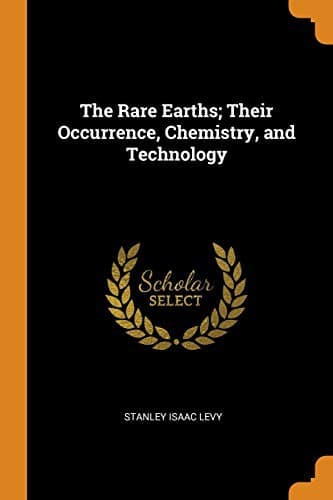
The Rare Earths: Their Occurrence, Chemistry, and TechnologyLevy, Stanley Isaac
Science
The Rare Earths: Their Occurrence, Chemistry, and Technology
Levy, Stanley Isaac
Rare earths
Addition of hydrogen peroxide to a neutral or acid solution of a
titanium compound gives a yellow colour, due to the formation of a
peroxide, TiO₃,aq. Such solutions have the same oxidising powers as
hydrogen peroxide, but do not give the blue colouration with chromium
salts. By treatment of the solution with dilute alkalies, an hydrated
peroxide is thrown down, which, when dried over phosphoric anhydride,
has the formula TiO₃,3H₂O, and forms a yellow, horny mass. The freshly
precipitated peroxide dissolves in acids and alkalies; from the latter
solutions, by addition of hydrogen peroxide and alcohol, pertitanates of
various composition can be obtained, of which the following are
examples : Na₂O₂,TiO₃,3H₂O; (NH₄)₂O₂,TiO₃,H₂O₂; BaO₂,TiO₃,5H₂O;
K₂O₄,K₂O₂,TiO₃,10H₂O, etc. These salts lose hydrogen peroxide when
treated with dilute acids, and their constitutions are unknown.
An interesting series of fluoroxypertitanates has been prepared by
oxidation of the solution of titanium dioxide in hydrofluoric acid with
hydrogen peroxide, and addition of metallic fluorides. The ammonium
compound, (NH₄)₃TiO₂F₅, crystallises in yellow octahedra, isomorphous
with the salts ZrF₄,3NH₄F and CbOF₃,3NH₄F. The potassium salt, K₂TiO₂F₄,
crystallises well from water, and is easily obtained in the pure state;
various barium salts are known. Similar compounds with oxalic acid have
also been prepared.
~Atomic Weight of Titanium.~--The first reliable determinations of this
constant were carried out by H. Rose in 1829. He determined the ratio
TiCl₄ : 4AgCl, by dissolving the pure tetrachloride, weighed in sealed
glass bulbs, in water in closed flasks, precipitating the dioxide by
ammonia, and weighing the silver chloride obtained by adding silver
nitrate to the filtered and acidified solution. He obtained the values
48·27 and 48·13, which agree very well with the accepted value, 48·1. In
the same year, Mosander, using a method not specified, obtained the
value 47·15. Determinations carried out by Pierre (1847) and Demoly
(1849) led to widely varying results. A series of determinations carried
out by Thorpe during the years 1883-1885 gave consistent results. The
method used was the precipitation of silver halide from the
tetrachloride and tetrabromide, and the mean value of seven series of
determinations gave the number 48·08. The International Committee have
adopted this result as the basis of the accepted value, 48·1.
~Detection.~--The specific reactions for the element are frequently
masked by the presence of other metals, especially of iron, columbium,
tantalum, and vanadium, which most frequently accompany it in nature,
and from which a quantitative separation is frequently very difficult
(see p. 338). The most characteristic reactions are the following:
Public-domain text, read in full here on John Shaqi.
Reviews
Reviews
No reviews yet
Be the first to share your thoughts on this work.
Elsewhere in the archive
Join the Discussion
Join the discussion
Sign in to leave a comment or review.
Sign InorCreate an account