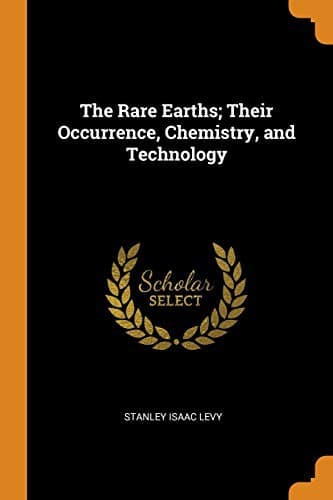
The Rare Earths: Their Occurrence, Chemistry, and TechnologyLevy, Stanley Isaac
Science
The Rare Earths: Their Occurrence, Chemistry, and Technology
Levy, Stanley Isaac
Rare earths
(1) Reduction in acid solution by means of tin or zinc gives an
intense violet colour, due to the formation of trivalent titanium
salts. Various colours are given by vanadium, columbium, and tungsten,
so that the test is not decisive if these are present.
(2) Hydrogen peroxide in acid solution gives a reddish-yellow colour,
which is very delicate, and is used in quantitative estimation;
vanadium compounds interfere.
(3) In sulphuric acid solution, characteristic colours are obtained
with many phenolic compounds; thymol gives a blood-red colour which is
exceedingly intense.
(4) A very characteristic and intense colour is given in acid solution
on the addition of 1:8-dihydroxynaphthalene-2:4-disulphonic acid
(chromotropic acid).
The methods for the estimation of titanium are given in Chapter XXII.
CHAPTER XVI
THE GROUP IVA ELEMENTS (_continued_)--ZIRCONIUM AND THORIUM
~Zirconium~, Zr = 90·6
The oxide zirconia was isolated as a new earth from zircon from Ceylon
by Klaproth in 1789; six years later the new earth was obtained also
from hyacinth, the gem-variety of the same mineral. The new oxide was
examined in 1818 by Berzelius, who pointed out its resemblance to
alumina, and gave it the formula Zr₂O₃; during the next two decades he
thoroughly investigated its properties, preparing the element itself,
and determining its equivalent. In 1857 a determination of the vapour
density of the chloride, by Deville and Troost, showed that the element
is really tetravalent, and that the formula ZrO₂ must be assigned to the
oxide; this formula was shown to accord with the isomorphism of rutile
(TiO₂) and zircon (ZrO₂,SiO₂) by Rose in 1859, whilst in the following
year Marignac observed the isomorphism between the fluozirconates of
zinc and nickel and the fluosilicates, fluotitanates, and fluostannates
of these metals. The homogeneity of the oxide has been questioned;
Svanberg in 1845 considered it to be a mixture of at least three earths,
whilst Sorby and Forbes in 1869 claimed to have discovered in it a new
oxide, ‘Jargonia.’ These claims, however, have been shown to have been
founded on inaccurate experimental work, and the individuality of the
element is at the present time considered to be well established.
Zirconium is fairly widely distributed in nature, but generally in very
small quantities, and can be rightly classed as one of the rarer
elements. It occurs in some silicates, and in small quantities in almost
all the rare earth minerals. The most important source of the element
and its compounds was until quite recently the mineral Zircon, with its
gem-varieties Hyacinth and Jargon, and the large number of secondary
altered zircon minerals. Since its discovery in 1892, however, the
naturally occurring oxide, Baddeleyite,[455] has become increasingly
important for the extraction of zirconium compounds, especially for the
preparation of the pure oxide for fire-resistant materials.
Public-domain text, read in full here on John Shaqi.
Reviews
Reviews
No reviews yet
Be the first to share your thoughts on this work.
Elsewhere in the archive
Join the Discussion
Join the discussion
Sign in to leave a comment or review.
Sign InorCreate an account