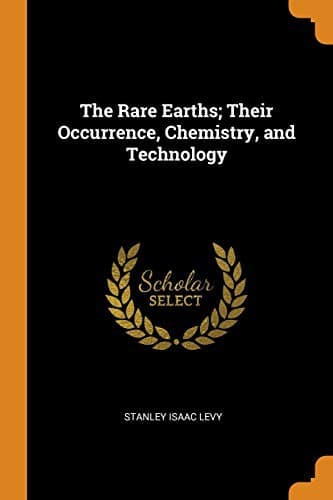
The Rare Earths: Their Occurrence, Chemistry, and TechnologyLevy, Stanley Isaac
Science
The Rare Earths: Their Occurrence, Chemistry, and Technology
Levy, Stanley Isaac
Rare earths
~Ilmenite or Menaccanite~ (Specular Iron Ore, Titaniferous Ironstone,
etc.).--This is a titanate of iron, usually written FeTiO₃. Its
constitution has given rise to very considerable discussion[57]; not
only do the relative proportions of iron and titanium vary greatly, but
the iron is undoubtedly present in both the ferrous and the ferric
states, and in the former state is partly replaced in some specimens by
manganese and magnesium. In 1829 Mosander put forward the view that the
mineral consisted of FeTiO₃, ferrous titanate, with varying proportions
of ferric oxide, the forms and angles of ilmenite being very similar to
those of hæmatite, Fe₂O₃. This view was disputed by H. Rose, who
concluded that the mineral must have been originally an isomorphous
mixture of ferric oxide, Fe₂O₃, and titanic oxide, Ti₂O₃, which on
exposure to high temperature in the earth’s crust would change according
to the equation
Fe₂O₃ + Ti₂O₃ = 2TiO₂ + 2FeO
so that the proportion of ferrous iron increases with the proportion of
titanium dioxide, as is actually found to be the case. This condition,
however, is also satisfied by Mosander’s view. The latter view was also
supported by Rammelsberg, who pointed out that the presence of magnesium
indicated the existence of ferrous iron as a primary constituent.
Additional support is lent to this view by the discovery of Pyrophanite,
MnTiO₃ (see list), which is found to be isomorphous with ilmenite, so
that there can be little doubt that MgTiO₃, which can be only a
titanate, would, if it existed in the crystalline form (see Geikielite
in list), also be isomorphous with ilmenite. Friedel and Guérin (1876)
prepared artificial titanium sesquioxide, Ti₂O₃, and found it to be
isomorphous with hæmatite, Fe₂O₃; they concluded that FeFeO₃, FeTiO₃ and
TiTiO₃ formed an isomorphous series, and that ilmenite was a mixture of
the second with the other two. In 1890 Hamberg pointed out that there
was no reason to suppose that hæmatite, Fe₂O₃, contains ferrous iron,
_i.e._ has the constitution Fe´´Fe^{iv}O₃, analogous to Fe´´Ti^{iv}O₃,
since in corundum, the analogous compound of aluminium, Al₂O₃, divalent
aluminium can hardly exist; nevertheless, strict analogy of constitution
is not necessary for isomorphism, as shown by the case of potassium
nitrate, KNO₃, and aragonite, CaCO₃, so that hæmatite, Fe₂O₃, and
ferrous titanate, FeTiO₃, might form solid solutions in varying
proportions without the strictly analogous formula FeFeO₃ being true for
the former. The balance of opinion inclines to the constitution
(_m_FeTiO₃ + _n_Fe₂O₃ in isomorphous mixture) originally proposed by
Mosander. The evidence in support of this view has been greatly
strengthened by the recent work of Manchot,[58] which has proved the
absence of titanium sesquioxide, Ti₂O₃; the mineral is therefore to be
regarded as a titanate.
[57] For a full account of the earlier work on the constitution of
ilmenite _vide_ Hintze, i. 1858 _et seq._
Public-domain text, read in full here on John Shaqi.
Reviews
Reviews
No reviews yet
Be the first to share your thoughts on this work.
Join the Discussion
Join the discussion
Sign in to leave a comment or review.
Sign InorCreate an account