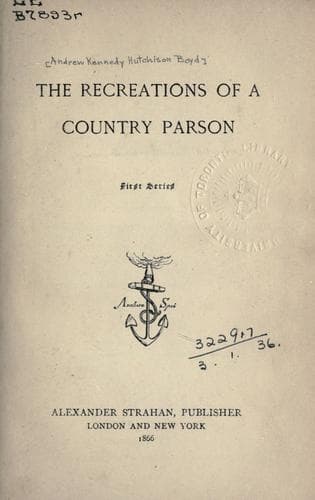
The Recreations of a Country ParsonBoyd, Andrew Kennedy Hutchison
General
The Recreations of a Country Parson
Boyd, Andrew Kennedy Hutchison
Clergy -- Anecdotes; Country life -- England; Rural clergy -- England
And there can be little doubt, that when you gird up the mind, and
put it to its utmost stretch, it is best that you should be alone.
Even when the studious man comes to have a wife and children, he
finds it needful that he should have his chamber to which he may
retire when he is to grapple with his task of head-work; and he
finds it needful, as a general rule, to suffer no one to enter that
chamber while he is at work. It is not without meaning that this
solitary chamber is called a study: the word reminds us that hard
mental labour must generally be gone through when we are alone.
Any interruption by others breaks the train of thought; and the
broken end may never be caught again. You remember how Maturin,
the dramatist, when he felt himself getting into the full tide of
composition, used to stick a wafer on his forehead, to signify to
any member of his family who might enter his room, that he must
not on any account be spoken to. You remember the significant
arrangement of Sir Walter's library, or rather study, at Abbotsford;
it contained one chair, and no more. Yes, the mind's best work, at
the rate of writing, must be done alone. At the speed of talking,
the case is otherwise. The presence of others will then stimulate
the mind to do its best; I mean to do the best it can do at that rate
of speed. Talking with a clever man, on a subject which interests
you, your mind sometimes produces material which is (for you) so good,
that you are truly surprised at it. And a barrister, addressing a
judge or a jury, has to do hard mental work, to keep all his wits
awake, to strain his intellect to the top of its bent, in the
presence of many; but, at the rate of speed at which he does this,
he does it all the better for their presence. So with an extempore
preacher. The eager attention of some hundreds of his fellow-creatures
spurs him on (if he be mentally and physically in good trim) to do
perhaps the very best he ever does. I have heard more than two or
three clergymen who preach extempore (that is, who trust to the
moment for the words entirely, for the illustration mainly, and
for the thought in some degree), declare that they have sometimes
felt quite astonished at the fluency with which they were able
to express their thoughts, and at the freshness and fulness with
which thoughts crowded upon them, while actually addressing a great
assemblage of people. Of course, such extemporaneous speaking is
an uncertain thing. It is a hit or a miss. A little physical or
mental derangement, and the extempore speaker gets on lamely enough;
he flounders, stammers, perhaps breaks down entirely. But still, I
hold that though the extempore speaker may think and say that his
mind often produces extempore the best material it ever produces,
it is in truth only the best material which it can produce at the
rate of speaking: and though the freshly manufactured article,
warm from the mind that makes it, may interest and impress at the
Public-domain text, read in full here on John Shaqi.
Reviews
Reviews
No reviews yet
Be the first to share your thoughts on this work.
Elsewhere in the archive
Join the Discussion
Join the discussion
Sign in to leave a comment or review.
Sign InorCreate an account