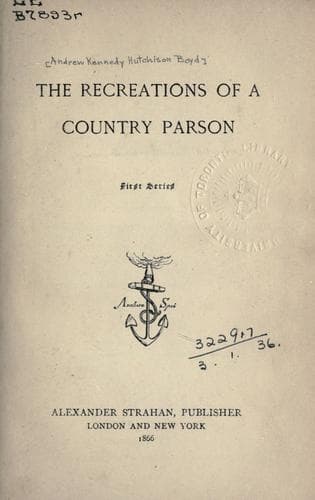
The Recreations of a Country ParsonBoyd, Andrew Kennedy Hutchison
General
The Recreations of a Country Parson
Boyd, Andrew Kennedy Hutchison
Clergy -- Anecdotes; Country life -- England; Rural clergy -- England
moment, we all know how loose, wordy, and unsymmetrical such a
composition always is: and it is unquestionable that the very best
product of the human soul must be turned off, not at the rate of
speaking, but at the much slower rate of writing: yes, and oftentimes
of writing with many pauses between the sentences, and long musing
over individual phrases and words. Could Mr. Tennyson have spoken
off in half-an-hour any one of the Idylls of the Kingt Could he
have said in three minutes any one of the sections of In Memoriam?
And I am not thinking of the mechanical difficulty of composition
in verse: I am thinking of the simple product in thought. Could
Bacon have extemporized at the pace of talking, one of his Essays?
Or does not Ben Jonson sum up just those characteristics which
extempore composition (even the best) entirely wants, when he tells
us of Bacon that 'no man ever wrote more neatly, more pressly; nor
suffered less emptiness, less idleness, in that he uttered?' I take
it for granted, that the highest human composition is that which
embodies most thought, experience, and feeling; and that must be
produced slowly and alone.
And if a man's whole heart be in his work, whether it be to write
a book, or to paint a picture, or to produce a poem, he will be
content to make his life such as may tend to make him do his work
best, even though that mode of life should not be the pleasantest
in itself. He may gay to himself, I would rather be a great poet
than a very cheerful and happy man; and if to lend a very retired
and lonely life be the likeliest discipline to make me a great poet,
I shall submit to that discipline. You must pay a price in labour
and self-denial to accomplish any great end. When Milton resolved
to write something 'which men should not willingly let die,' he knew
what it would cost him. It was to be 'by labour and intent study,
which I take to be my portion in this life.' When Mr. Dickens wrote
one of his Christmas Books, he shut himself up for six weeks to
do it; he 'put his whole heart into it, and came out again looking
as haggard as a murderer.' There is a substratum of philosophic
truth in Professor Aytoun's brilliant burlesque of Firmilian. That
gentleman wanted to be a poet. And being persuaded that the only
way to successfully describe tragic and awful feelings was to have
actually felt them, he got into all kinds of scrapes of set purpose,
that he might know what were the actual sensations of people
in like circumstances. Wishing to know what are the emotions of a
murderer, he goes and kills somebody. He finds, indeed, that feelings
sought experimentally prove not to be the genuine article: still,
you see the spirit of the true artist, content to make any sacrifice
to attain perfection in his art. The highest excellence, indeed,
in some one department of human exertion is not consistent with
decent goodness in all: you dwarf the remaining faculties when
you develop one to abnormal size and strength. Thus have men been
Public-domain text, read in full here on John Shaqi.
Reviews
Reviews
No reviews yet
Be the first to share your thoughts on this work.
Elsewhere in the archive
Join the Discussion
Join the discussion
Sign in to leave a comment or review.
Sign InorCreate an account