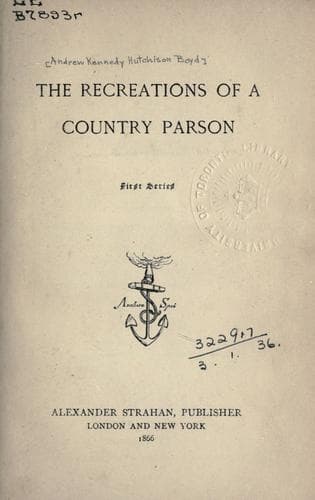
The Recreations of a Country ParsonBoyd, Andrew Kennedy Hutchison
General
The Recreations of a Country Parson
Boyd, Andrew Kennedy Hutchison
Clergy -- Anecdotes; Country life -- England; Rural clergy -- England
No: I cannot get on. I cannot forget that May magazine that is lying
in the corner. I must be thoroughly done with it before I can fix
my thoughts upon the work which is to be considered. Mr. Buckle has
done a service to my mind, entirely analogous to that which would
be done to a locomotive engine by a man who should throw a handful
of sand into its polished machinery. I am prepared, from personal
experience, to meet with a flat contradiction his statement that
a man does you no harm by trying to cast doubt and discredit upon
the doctrines you hold most dear. Mr. Buckle, by his article, has
done me an injury. It is an injury, irritating but not dangerous.
For the large assertions, which if they stated truths, would show
that the religion of Christ is a miserable delusion, are unsupported
by a tittle of proof: and the general tone in regard to Christianity,
though sufficiently hostile, and very eloquently expressed, appears
to me uncommonly weak in logic. But as Mr. Buckle's views have
been given to the world, with whatever weight may be derived from
their publication in this magazine, it is no more than just and
necessary that through the same channel there should be conveyed
another contributor's strong disavowal of them, and keen protest
against them. I do not intend to argue against Mr. Buckle's
opinions. This is not the time or place for such an undertaking.
And Mr. Buckle, in his article, has not argued but dogmatically
asserted, and then called hard names at those who may conscientiously
differ from him. Let me suggest to Mr. Buckle that such names can
very easily be retorted. Any man who would use them, very easily
could. Mr. Buckle says that any man who would punish by legal means
the publication of blasphemous sentiments, should be regarded as
a noxious animal. It is quite easy for me to say, and possibly to
prove, that the man who advocates the free publication of blasphemous
sentiments, is a noxious animal. So there we are placed on an
equal footing; and what progress has been made in the argument of
the question in debate? Then Mr. Buckle very strongly disapproves
a certain judgment of, as I believe, one of the best judges who
ever sat on the English Bench: I mean Mr. Justice Coleridge. That
judge on one occasion sentenced to imprisonment a poor, ignorant
man, convicted of having written certain blasphemous words upon
a gate. I am prepared to justify every step that was taken in the
prosecution and punishment of that individual. That, however, is
not the point at issue. Even supposing that the magistrates who
committed, and the judge who sentenced, that miserable wretch,
had acted wrongly and unjustly, could not Mr. Buckle suppose that
they had acled conscientiously? What right had he to speak of Mr.
Justice Coleridge as a 'stony-hearted man?' What right had he to
say that the judge and the magistrates, in doing what they honestly
believed to be right, were 'criminals,' who had 'committed a great
Public-domain text, read in full here on John Shaqi.
Reviews
Reviews
No reviews yet
Be the first to share your thoughts on this work.
Elsewhere in the archive
Join the Discussion
Join the discussion
Sign in to leave a comment or review.
Sign InorCreate an account