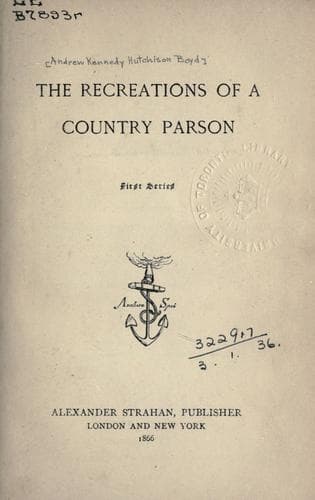
The Recreations of a Country ParsonBoyd, Andrew Kennedy Hutchison
General
The Recreations of a Country Parson
Boyd, Andrew Kennedy Hutchison
Clergy -- Anecdotes; Country life -- England; Rural clergy -- England
crime?' What right had he to say that their motives were 'the pride
of their power and the wickedness of their hearts?' What right had
he to call one of the most admirable men in Britain 'this unjust
and unrighteous judge?' And where did Mr. Buckle ever see anything
to match the statement, that Mr. Justice Coleridge grasped at the
opportunity of persecuting a poor blasphemer in a remote county,
where his own wickedness was likely to be overlooked, while he durst
not have done as much in the face of the London press? Who will
believe that Mr. Justice Coleridge is distinguished for his 'cold
heart and shallow understanding?' But I feel much more comfortable
now, when I have written upon this page that I, as one humble
contributor to this Magazine, utterly repudiate Mr. Buckle's
sentiments with regard to Sir J. T. Coleridge, and heartily condemn
the manner in which he has expressed them.
If there be any question which ought to be debated with scrupulous
calmness and fairness, it is the question whether it is just that
human laws should prevent and punish the publication of views
commonly regarded as blasphemous. I deny Mr. Buckle's statement,
that all belief is involuntary. I say that in a country like this,
every man of education is responsible for his religious belief; but
of course responsible only to his Maker. Thus, on totally different
grounds from Mr. Buckle, I agree with him in thinking that no
human law should interfere with a man's belief. I am not prepared,
without much longer thought than I have yet given to the subject,
to agree with Mr. Buckle and Mr. Mill, that human law should never
interfere with the publication of opinions, no matter how blasphemous
they may be esteemed by the great majority of the nation to which
they are published. I might probably say that I should not interfere
with the publication of any book, however false and mischievous
I might regard the religious doctrines it taught, provided the
book were written in the interest of truth--provided its author
manifestly desired to set out doctrines which he regarded as true
and important. But if the book set out blasphemous doctrine in
such a tone and temper as made it evident that the writer's main
intention was to irritate and distress those who held the belief
regarded as orthodox, I should probably suppress or punish the
publication of such a book. Sincere infidelity is a sad thing, with
little of the propagandist spirit. Even if it should think that
those Christian doctrines which afford so much comfort and support
to men are fond delusions, I think its humane feeling would be,--Well,
I shall not seek to shatter hopes which I cannot replace. I know
that such was the feeling of the most amiable of unbelievers--David
Hume. I know how he regularly attended church, anxious that he might
not by his example dash in humble minds the belief which tended
to make them good and happy, though it was a belief which he could
not share.
Public-domain text, read in full here on John Shaqi.
Reviews
Reviews
No reviews yet
Be the first to share your thoughts on this work.
Elsewhere in the archive
Join the Discussion
Join the discussion
Sign in to leave a comment or review.
Sign InorCreate an account