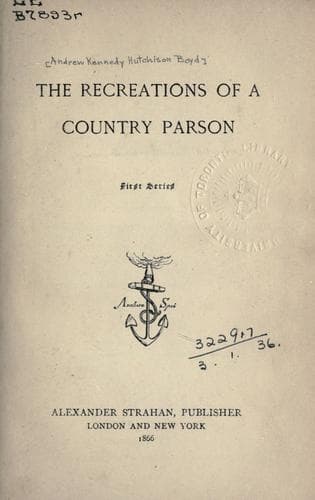
The Recreations of a Country ParsonBoyd, Andrew Kennedy Hutchison
General
The Recreations of a Country Parson
Boyd, Andrew Kennedy Hutchison
Clergy -- Anecdotes; Country life -- England; Rural clergy -- England
There is an interesting introduction, which gradually prepares us
for the announcement of the startling fact, that all men hitherto
have been entirely mistaken in their belief both as to themselves
and the universe which surrounds them. It is first impressed upon
us that things may be in themselves very different indeed from
that which they appear to us: that phenomenon may be something far
apart from actual being. Yet though our conceptions, whether given
by sense or intellect, do not correspond with the truth of things,
still they are the elements from which truth is to be gathered.
The following passage, which occurs near the beginning of the
introduction, is the sharp end of the wedge:--
All advance in knowledge is a deliverance of man from himself.
Slowly and painfully we learn that he is not the measure of truth,
that the fact may be very different from the appearance to him.
The lesson is hard, but the reward is great. So he escapes from
illusion and error, from ignorance and failure. Directing his
thoughts and energies no longer according to his own impressions,
but according to the truth of things, he finds himself in possession
of an unimaginable power alike of understanding and of acting. To
a truly marvellous extent he is the lord of nature.
But the conditions of this lordship are inexorable. They are the
surrender of prepossessions, the abandonment of assumption, the
confession of ignorance: the open eye and the humble heart. Hence
in all passing from error to truth we learn something respecting
ourselves, as well as something respecting the object of our study.
Simultaneously with our better knowledge we recognize the reason
of our ignorance, and perceive what defect on our part has caused
us to think wrongly.
Either the world is such as it appears to us, or it is not. If
it be not, there must be some condition affecting ourselves which
modifies the impression we receive ffom it. And this condition must
be operative upon all mankind: it must relate to man as a whole
rather than to individual men.
Thus does the author lay down the simple, general principle from
which he is speedily to draw conclusions so startling. Nothing can
be more innocuous than all this. Every one must agree in it. Now
come the further steps.
The study of nature leads to the conclusion that there is a
defectiveness in man which modifies his perception of all external
things; and that thus in so far as the actual fact of the universe
differs from our impression of it, the actual fact is better, higher,
more complete, than our impression of it. There are qualities,
there is a glory about the universe, which our defective condition
prevents our seeing or discerning. The universe, or nature, is not
in itself such as it is to man's feeling; and man's feeling of it
differs from the fact liy defect. All that we discern in the universe
is there: and a great deal besides.
Public-domain text, read in full here on John Shaqi.
Reviews
Reviews
No reviews yet
Be the first to share your thoughts on this work.
Elsewhere in the archive
Join the Discussion
Join the discussion
Sign in to leave a comment or review.
Sign InorCreate an account